
Search Results
242 Results Found for “stroke”

Meet the cardiologists shaping the future of the specialty. Our touchCARDIO Future Leaders 2026 are rising stars nominated by the cardiology community for their contributions to research, clinical practice and innovation. Discover the clinicians and researchers challenging convention, advancing care and driving progress across cardiology.
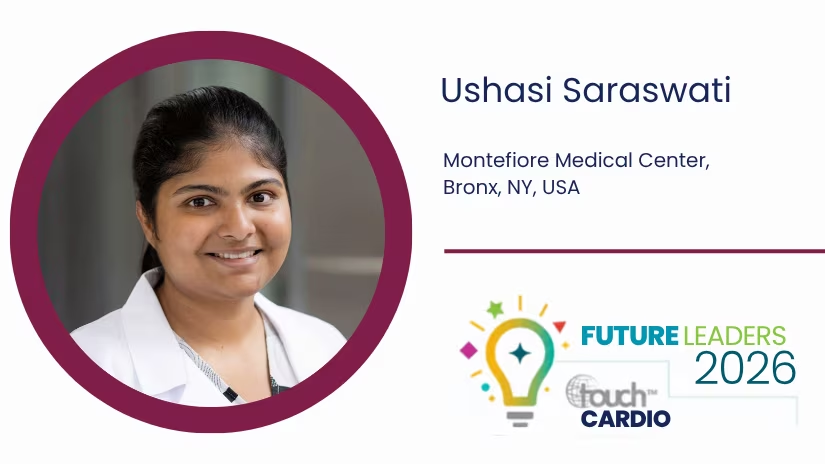
Dr Ushasi Saraswati is a physician specialising in cardiovascular medicine and touchCARDIO Future Leader 2026. In this interview, she discusses her journey into cardiology, the mentors who shaped her approach to medicine, the rewarding experience of caring for a patient with a complex diagnosis, and the importance of combining scientific curiosity and clinical expertise with compassion, clear communication and a commitment to patient-centred care.

ABLATE versus PACE: Pacemaker strategy reduces clinically relevant events in older patients with persistent atrial fibrillation Randomised trial shows substantially fewer hospitalisations and repeat interventions than pulmonary vein isolation. The benefit was partly offset by more heart failure events and ...

Dr Jonathan Piccini discusses rhythm control in patients with atrial fibrillation and heart failure with preserved ejection fraction, the growing role of catheter ablation, and the evidence still needed to define its impact on cardiovascular outcomes.

Cardiovascular diseases (CVDs) are the leading cause of morbidity and mortality worldwide.1 High systolic blood pressure (SBP) remains one of the top risk factors for CVD burden globally.2 Despite being a modifiable risk factor, hypertension (HTN) remains largely undiagnosed and ...

Prof. Jonathan Kalman discusses the rapid uptake of pulsed field ablation, its potential advantages over thermal ablation, and how the role of AF ablation may continue to expand.

The first dedicated ESC Guidelines on the management of cardiovascular disease and chronic kidney disease recommend kidney function and urine albumin testing in all patients with cardiovascular disease, with an emphasis on identifying CKD early and initiating effective treatment without delay.

Direct oral anticoagulant (DOAC) therapy reduced adverse clinical events compared with no anticoagulation in patients with atrial fibrillation (AF) at intermediate risk of stroke, according to results from the SINGLE-AF trial presented during a Hot Line session at ESC Congress 2026.1

New heart failure guidelines, practice-changing Hot Line data, artificial intelligence and new evidence in atrial fibrillation and cardiac amyloidosis are among the highlights to look out for on the opening day of ESC Congress 2026.

ESC Congress 2026 begins in Munich on August 28, bringing four days of new cardiovascular research, clinical guidance and discussion. Early data released ahead of the meeting provide a first look at some of the science to come.
Long-term consumption of sugar-sweetened beverages and fruit juice, beginning in childhood, was associated with a higher likelihood of hypertension in adulthood, according to findings published in Circulation.

The American Heart Association (AHA), American College of Cardiology (ACC), American Diabetes Association (ADA) and American Society of Nephrology (ASN) have issued a new joint clinical practice guideline for the prevention, detection, evaluation and management of cardiovascular-kidney-metabolic (CKM) syndrome.

Ventricular fibrillation (VF) is characterized by rapid (>300 beats a per minute), irregular electrical activation with variable electrocardiographic waveforms that prevents coordinated myocardial contraction, resulting in immediate loss of cardiac output.1 It most commonly occurs in the context of coronary ...

Cardiovascular care continues to evolve in response to increasingly complex clinical realities, where advances in intervention, electrophysiology and population health must be integrated with a more critical appraisal of long-held assumptions. Across disciplines, there is a growing recognition that improving ...

Hypertension is the leading modifiable risk factor for global cardiovascular disease, responsible for an estimated 10.8 million deaths and more than 200 million disability-adjusted life years annually.1 Despite the availability of effective pharmacological and lifestyle interventions, prevalence continues to rise, particularly in ...

touchCARDIO Future Leaders 2026 Following the successful introduction last year of our touchCARDIO Future Leaders, we are delighted to announce that nominations are now open for the 2026 edition. This initiative celebrates the next generation of pioneers in cardiology, those whose passion, ...

Sudden cardiac arrest (SCA) in young adults (typically defined as individuals younger than 40 years) has emerged as an important yet under-recognized public health concern. Recent estimates suggest an incidence of approximately 1–4 cases per 100,000 person-years, underscoring the clinical and epidemiological relevance ...
After decades of debate, patent foramen ovale (PFO) closure is now a well-established strategy to reduce recurrent stroke in patients aged 18–60 years who have had a PFO-associated stroke.1 Patients who underwent PFO closure continue to have a higher stroke risk ...
Log into your Touch Account
Keep track of your clinical interests and newsletter subscriptions.
Sign up with an Email
Or use a .
Register now for FREE access
Already registered? Login below.
