
Search Results
23 Results Found for “tricuspid regurgitation”
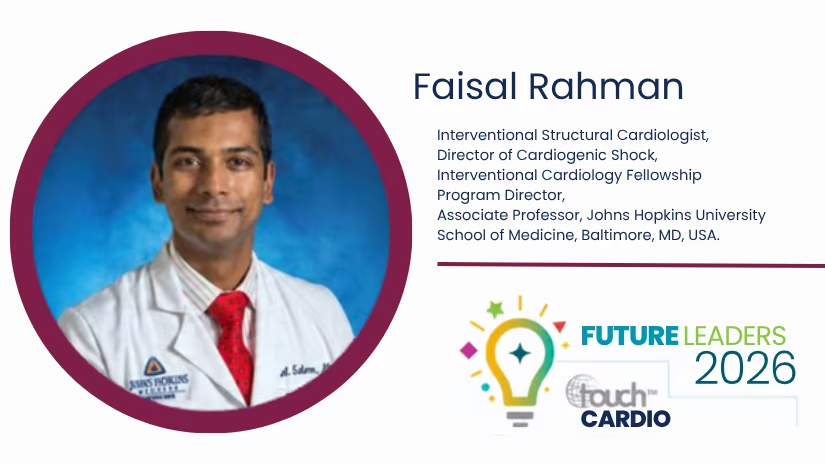
Dr Faisal Rahman is an interventional structural cardiologist and touchCARDIO Future Leader 2026. In this interview, he discusses his journey into cardiology, the mentors and role models who shaped his career, the rewards of caring for complex patients and developing trainees, and his vision for advancing cardiogenic shock, structural heart disease, research and education.

Transthyretin amyloid cardiomyopathy (ATTR-CM) is an inexorably progressive and ultimately fatal cardiomyopathy characterized by the deposition of misfolded transthyretin (TTR) in the form of amyloid fibrils within the myocardium.1 Transthyretin amyloid (ATTR) fibrils are insoluble protease-resistant beta-pleated sheets that are ...

Conduction system pacing (CSP) is being increasingly adopted as a more physiological alternative to right ventricular and biventricular pacing and is an integral part of the European Heart Rhythm Association (EHRA) core curriculum for the device specialist.1–6 Left bundle branch ...

On April 25, 2025, the FDA approved the OmniaSecure defibrillation lead, a 1.6 mm, catheter-delivered, lumenless lead for right ventricular implantation. The small-diameter lead is designed to connect to an implantable defibrillator and treat ventricular tachyarrhythmias, ventricular fibrillation, and bradyarrhythmias, with LEADR trial data showing high implant success, safety, and electrical performance.

Welcome to this issue of Heart International. As ever, we aim to provide our readers with the latest developments, insights, and evidence-based discussions in cardiovascular care. This edition is particularly poignant, as we begin with a heartfelt tribute to an ...

As 2024 draws to a close, we’re celebrating a wonderful year of content. From insightful expert Q&As and peer-reviewed articles to conference highlights and a wealth of medical education, it’s been a year filled with content that we hope has been useful to our audience. We’ve had the privilege of connecting with leading experts and working alongside medical societies to support the cardiology community with high-quality, easily accessible content.

Tricuspid regurgitation (TR) is a frequent finding on echocardiography, with detection rates reaching up to 86% across the different ranges of severity, with moderate or greater TR being reported in at least 6–8% of patients.1–3 The prevalence of TR increases with age, ...
Welcome to the summer issue of Heart International. We are excited to present a collection of insightful articles that delve into various aspects of cardiovascular health and related interventions. This issue encompasses a wide array of topics, from novel treatment ...

The third European Pacing Symposium (EPS) meeting took place on Friday 1 December 2023 in London, UK. The event, which brings together an international faculty to discuss the latest advances in cardiac pacing and implantable cardioverter-defibrillators (ICDs) provides attendees with practical sessions ...

Clinically relevant tricuspid regurgitation (TR) is a common disorder, affecting approximately 4% of people 75 years of age or older.1 If left untreated, severe TR results in volume overload and right ventricular remodelling. This eventually leads to symptomatic right-sided heart failure, along ...

For decades, right ventricular pacing (RVP) has been the leading pacing technique and has been proven to be effective in treating patients with symptomatic bradycardia. However, dyssynchrony caused by non-physiological ventricular activation results in pacing-induced cardiomyopathy occurs in approximately 15% of ...

Bradycardia, renal failure, atrioventricular nodal blockade, shock and hyperkalemia (BRASH) syndrome is a rare, often unrecognized but potentially life-threatening clinical entity that is characterized by the pentad of symptoms after which it is named. BRASH syndrome is seen most commonly ...

The global prevalence of aortic stenosis (AS) has steadily increased over the past several decades.1 In high-income countries, degenerative calcific aortic valve disease is the primary aetiology for AS, whereas chronic rheumatic valve disease and infective endocarditis remain more common ...

The bRIGHT study aimed to evaluate the safety and effectiveness of the TriClip device in symptomatic patients with severe tricuspid regurgitation. In this touchCARDIO interview, we speak with Professor Erwan Donal (University Hospital of Rennes, Rennes, France) to discuss tricuspid ...
As of the publication of this article, the coronavirus disease 2019 (COVID-19) infection has affected over 400 million people around the world and caused over 6 million deaths.1 Although COVID-19 infection predominantly affects the respiratory system, studies have described a wide spectrum of ...

Tricuspid regurgitation (TR) is a complex disease with several independent causes. Consequently, outcomes and response to therapy vary widely. Severe or progressive TR often results in gradual right ventricular (RV) failure and is associated with poor long-term outcomes.1 Most cases ...

Cardiogenic shock (CS) is a life-threatening condition characterized by cardiac pump dysfunction resulting in end-organ hypoperfusion and hypoxia.1,2 Although multiple treatment strategies have been explored in clinical trials, optimal therapy for CS is still debatable and mortality remains substantially high ...
Log into your Touch Account
Keep track of your clinical interests and newsletter subscriptions.
Sign up with an Email
Or use a .
Register now for FREE access
Already registered? Login below.
