We are delighted to feature Dr Maxime Caru as a touchCARDIO Future Leader 2026, recognized as an emerging leader in cardio-oncology.
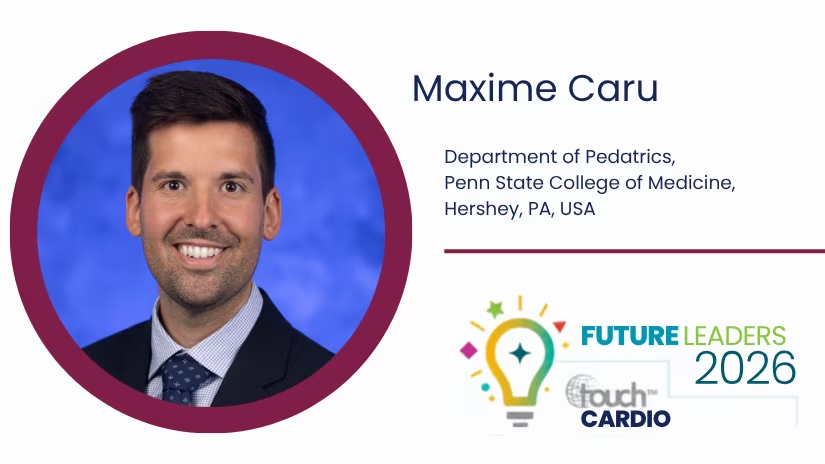
As part of the touchCARDIO Future Leaders series, we are pleased to feature Dr Maxime Caru, PhD, PhD, an Assistant Professor in the Department of Pediatrics at Penn State College of Medicine in Hershey, PA, USA. Dr Caru has a PhD in Exercise Physiology and a PhD in Psychology. He has completed a postdoctoral fellowship in Cardio-Oncology and Biomedical Engineering at Polytechnique Montréal, Canada and a postdoctoral fellowship in Pediatric Oncology at Penn State College of Medicine. Dr Caru’s work focuses on understanding how pediatric cancer treatments, particularly chemotherapy, affect long-term physiologic, cardiovascular and psychological outcomes. He uses exercise prescriptions to mitigate chemotherapy-related cardiotoxicity in childhood cancer survivors. And more recently, Dr Caru has started investigating how physical-activity–based health behaviour change can improve patient-reported outcomes among children, adolescents and young adults with cancer, as well as cancer survivors, with an emphasis on the implementation and sustainability of behavioural interventions.
Dr Caru is currently the Director of the ONE (Oncology, Nutrition and Exercise) Group and the INSPIRE Team (Investigator-Initiated Non-Therapeutic Supportive Research Trials in Pediatric Oncology) at Penn State Health Golisano Children’s Hospital and Penn State College of Medicine. He also serves as Chair of the Society of Behavioral Medicine Cancer Special Interest Group. Dr Caru believes that lifestyle changes through physical activity can be integrated into standard of care for pediatric patients living with and beyond cancer to improve cardiovascular outcomes.
New insights are added regularly, covering a broad range of subspecialties and evolving clinical scenarios. Sign up below for Free Access to the latest clinical updates in your specialty!
What inspired you to pursue a career in cardiology?
I have always been passionate about the cardiovascular system. The heart is one of the most important organs in the human body. It is the most powerful organ of the circulatory system, pumping blood to deliver oxygen throughout the body.
My first interaction with patients was in a cardiac rehabilitation center in France, where I was providing exercise sessions to improve their physical function and cardiorespiratory fitness after a cardiac event or surgery. My first research projects focused on physical activity as a key behavior to enhance cardiovascular outcomes in patients with cardiac diseases. While our main research focus was on the physiological and cardiovascular outcomes of these patients, we also realized the importance of social interactions during exercise sessions to improve patients’ well-being.
Through my research, I realized that pediatric cancer patients who undergo chemotherapy can exhibit subclinical dysfunctions and cardiac abnormalities, independent of cumulative dose exposure. Moreover, childhood cancer survivors’ cardiac profiles closely resembled those of adult cardiac patients. Consequently, I started investigating the effects of chemotherapy on cardiovascular outcomes in pediatric cancer patients and my interest toward physical activity in pediatric oncology became a priority to mitigate the chemotherapy-related cardiotoxicity in this unique population. Our work has demonstrated the protective role of regular physical activity against cardiovascular risk factors and has highlighted the urgent need to integrate physical activity into standard of care in oncology to reduce long-term cardiovascular risks and enhance survivorship in pediatric oncology.
Who has been the most significant mentor or role model for you, and what did you learn from them?
Over the course of my career, I have been fortunate to work with mentors who inspired me, challenged me to push beyond my perceived limits, and encouraged me to think creatively. Their guidance, support, and confidence in me have been instrumental in shaping my professional development and helping me achieve important career milestones.
Dr Claire Thomas-Junius, PhD, and Dr Philippe Lopes, PhD, provided my first opportunities in research. Both are experts in exercise physiology, and their courses introduced me to the physiologic foundations of sport performance. I was particularly inspired by the rigor of their work and by the generosity with which they shared their knowledge. They consistently supported my academic ambitions and believed in me when I chose to pursue further research training in Canada.
Dr Laurence Kern, PhD, played an important mentoring role as I pursued my PhD in Psychology. Her work on physical activity and psychosocial outcomes challenged me to look beyond the physiologic effects of exercise and to consider its broader influence on mental health.
Dr Daniel Curnier, PhD, has had one of the most significant influences on my career. As my master’s and doctoral supervisor at the Université de Montréal, he introduced me to the field of cardio-oncology and provided opportunities for me to pursue innovative research that placed patients at the center of each project. His expertise in exercise physiology and cardiology shaped my interest in pediatric cardio-oncology and helped establish the foundation for my work investigating chemotherapy-related cardiotoxicity in childhood cancer survivors.
Dr Delphine Périé-Curnier, PhD, also played a pivotal role in my development in cardio-oncology. As my postdoctoral supervisor, she guided my work examining the mechanical properties of the heart in patients with cancer. Her deep expertise in biomedical engineering strengthened my understanding of the complexity of cardiovascular research and motivated me to further develop my knowledge and skills in this area.
Dr Kathryn H. Schmitz, PhD, MPH, has been an especially influential mentor and role model. Her growing interest in pediatric oncology created the opportunity for me to join her lab as a postdoctoral fellow, an experience that ultimately led to my current position. Through her exceptional expertise in exercise oncology, I gained valuable experience in the design of exercise-oncology clinical trials and in the implementation of such interventions. She also emphasized the importance of building meaningful collaborations and generously connected me with experts worldwide; relationships that continue to strengthen my research program.
Finally, the pediatric oncology team at Penn State Health Golisano Children’s Hospital has served as an invaluable source of mentorship in clinical medicine. They have consistently supported my research and clinical programs while sharing their expertise and helping ensure that my work remains clinically relevant, feasible and centered on improving the lives of children, adolescents and young adults affected by cancer. Collectively, these mentors have shaped the way I approach research, collaboration and mentorship. Their examples have taught me the importance of combining scientific rigor with patient-centered care, interdisciplinary collaboration, and genuine support for trainees.
What has been the most rewarding moment in your journey so far?
The most rewarding moments in my journey are seeing our patients smile and have fun through the physical activity programs we offer at Penn State Health Golisano Children’s Hospital, with the support of Four Diamonds. During cancer treatment, children and adolescents spend so much time in their room, so being able to bring joy, movement, and a sense of normalcy into their day is incredibly meaningful.
Although I am committed to conducting impactful research in pediatric oncology and cardio-oncology, I never lose sight of the real-life impact of my work on our young patients and their families. It is especially rewarding to see how physical activity can support cardiovascular health. Improving cardiovascular outcomes helps improve survival.
I also find great fulfillment in sharing knowledge with the next generation of researchers, trainees, and medical students. By helping them understand the value of exercise and supportive care in pediatric oncology and cardio-oncology, I hope we can take meaningful steps toward making exercise a standard part of cancer care. One step at a time, our goal is to improve survivorship outcomes and help reduce the risk of treatment-related cardiotoxicity for pediatric cancer patients.
touchCARDIO is celebrating the brightest rising stars in the cardiology community, who are set to shape the future of the field.
See the full list of touchCARDIO Future Leaders 2026 winners here.
More content in interventional cardiology
Cite: Dr Maxime Caru on cardio-oncology and physical exercise: touchCARDIO Future Leader 2026. touchCARDIO. October 2026.
Disclosures: Dr Maxime Caru has received grant/research support from Four Diamonds, Penn State College of Medicine, Department of Pediatrics, Division of Hematology and Oncology. This short article was prepared by touchCARDIO in collaboration with Dr Maxime Caru. No fees or funding were associated with its publication.
Editor: Heather Hall, Managing Editor