EHRA

At EHRA 2026, Professor Claudio Tondo presents his highlights on advances in ablation and device technologies, led by pulsed field ablation, showcasing a rapidly evolving landscape in the treatment of complex arrhythmias.
Professor Amir Jadidi presented results from SOLVE-AF at EHRA 2026, showing that sinus rhythm–guided substrate ablation significantly improves outcomes in persistent AF patients with atrial fibrosis and supporting a more personalized ablation strategy.

At EHRA 2026, late-breaking trials across ablation, devices, and drug therapy signal major shifts in arrhythmia management, highlighting both rapid innovation and key unanswered questions. We spoke to Prof Jose Luis Merino for his highlights.

Presented at EHRA 2026 by Dr David Birnie, the OCEAN trial reveals low, brief atrial fibrillation recurrence rates after successful ablation - findings that may support selective anticoagulation discontinuation while reinforcing the need for ongoing follow-up.

From EHRA 2026, Dr Salik Ur Rehman discusses advances in pulsed field ablation, mapping technologies, and conduction system pacing highlight a rapidly evolving landscape in electrophysiology care.

At EHRA 2026, new research from Dr Kerollos Abdelsayed highlighted perioperative inflammation as a modifiable driver of conduction disturbances after TAVI, opening the door to novel pharmacologic and device-based solutions.

At EHRA 2026, new research presented by Professor Elaine Chew explores how music-based digital tools can enhance arrhythmia detection and enable personalized, AI-driven approaches to cardiovascular diagnosis and therapy.

At EHRA 2026, Pierre Jais presented results from the BEAT-PERS AF trial suggesting pulsed field ablation may offer a safer, effective alternative to radiofrequency ablation in persistent AF, prompting renewed focus on optimizing ablation strategies for this high-risk group.

At EHRA 2026, Ben Petrazzini discussed new research that shows AI can improve identification of sudden cardiac death in electronic health records, enabling more accurate large-scale studies and advancing prevention strategies.

Cardiovascular medicine in 2025 has been marked by rapid innovation and meaningful shifts in clinical practice. In this year-in-review, touchCARDIO brings together expert reflections highlighting paradigm-changing trial data, the emergence of pulsed field ablation and conduction system pacing, advances in imaging and prevention, and the accelerating integration of artificial intelligence. Collectively, these perspectives underscore a field evolving toward more precise, technology-enabled and preventive cardiovascular care, while emphasising the need to translate scientific progress into improved outcomes for patients worldwide.

Between 29 August and 1 September 2025, Madrid hosted one of the most globally ambitious gatherings in cardiovascular medicine: ESC Congress 2025, held alongside the World Congress of Cardiology. Under the unifying theme “Cardiology Beyond Borders,” the meeting spotlighted how cardiovascular disease is woven into broader global health challenges — from disparities in care access to climate, pandemics and social determinants of health. With over 33,000 participants from 169 countries, the Congress set new attendance records and featured more than 190 studies released in tandem with leading journals.
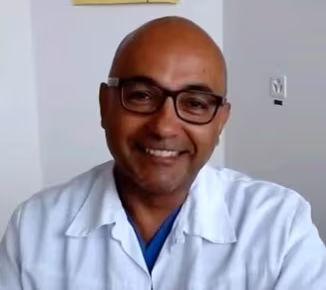
Cardiac implantable electronic devices are undergoing rapid change, with conduction system pacing and new strategies for resynchronization therapy challenging long-standing standards. At ESC 2025, Dr Haran Burri highlights late-breaking trial data that could redefine best practice and underscores the importance of careful technique and training to translate these advances into meaningful patient benefit.

Conduction system pacing (CSP) is being increasingly adopted as a more physiological alternative to right ventricular and biventricular pacing and is an integral part of the European Heart Rhythm Association (EHRA) core curriculum for the device specialist.1–6 Left bundle branch ...

In this Q&A, he shares insights into his career journey, the experiences that shaped his path and what excites him most about the future of cardiology.

For decades, right ventricular pacing (RVP) has been the leading pacing technique and has been proven to be effective in treating patients with symptomatic bradycardia. However, dyssynchrony caused by non-physiological ventricular activation results in pacing-induced cardiomyopathy occurs in approximately 15% of ...

A significant proportion of patients with atrial fibrillation (AF) who have a high stroke risk are currently being treated with oral anticoagulation (OAC), including direct oral anticoagulants (DOACs) and vitamin K inhibitors (VKAs).1 It is well known that the increased ...

The OptiVALL study aimed to assess the atrioventricular synchronous pacing capabilities of the Micra AV device, and to describe what programming changes are needed. In this touchCARDIO interview, we speak with Dr Sem Briongos Figuero (Hospital Infanta Leonor, Madrid, Spain) ...

 touchCARDIO
Register Now!
Explore the latest in medical education and stay current in your field. Create a free account to track your learning.
- Save your progress for video
- Keep track of your CME credits
- Add personalised learning notes
- Receive updates from course leaders and faculty
- Be the first to hear about new and exciting interactive learning opportunities
Log into your Touch Account
Keep track of your clinical interests and newsletter subscriptions.
Sign up with an Email
Or use a .
Register now for FREE access
Already registered? Login below.
