We are delighted to feature Dr Abhishek Chaturvedi as a touchCARDIO Future Leader 2026, recognized as an emerging leader in interventional and structural cardiology.
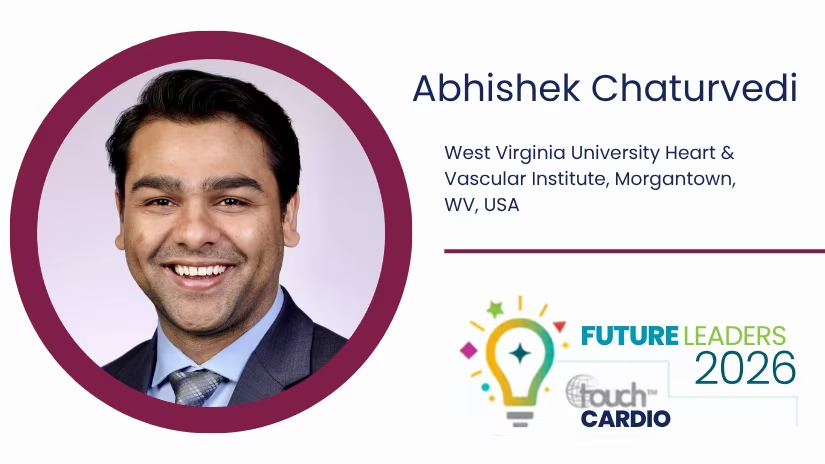
As part of the touchCARDIO Future Leader 2026 series, we are delighted to feature Dr Abhishek Chaturvedi of West Virginia University (WVU) School of Medicine and WVU Heart and Vascular Institute at Thomas Hospitals, Charleston, WV, USA and JW Ruby Memorial Hospital, Morgantown, WV, USA. Dr Chaturvedi is a cardiologist and clinician-scientist with interests spanning interventional and structural cardiology, cardiovascular outcomes research and global cardiovascular health. His career has been shaped by research at the US National Institutes of Health (NIH), where he investigated the role of inflammation in cardiovascular disease, and clinical experience caring for critically ill cardiac patients. He has also contributed to global health research through the Public Health Foundation of India and the Centre for Chronic Disease Control, exploring cardiovascular risk factors, healthcare disparities and prevention strategies in diverse populations. Combining clinical expertise with scientific curiosity, Dr Chaturvedi is committed to advancing cardiovascular medicine and improving patient outcomes through research, innovation and compassionate care.
In this interview, Dr Chaturvedi reflects on the experiences that inspired his career in cardiology, from his early fascination with cardiovascular physiology to the excitement of working in the cardiac catheterisation laboratory and the fulfilment of caring for patients across both inpatient and outpatient settings. He discusses the influential mentors who have shaped his professional development and the lessons they have taught him about humility, compassion and lifelong learning. He also shares what makes his work most rewarding, highlighting the privilege of caring for critically ill patients and the opportunity to make a wider impact through clinical research and global cardiovascular health initiatives. His perspective illustrates how clinical practice, scientific discovery and a commitment to improving care can come together to shape the next generation of cardiovascular leaders.
New insights are added regularly, covering a broad range of subspecialties and evolving clinical scenarios. Sign up below for Free Access to the latest clinical updates in your specialty!
What inspired you to pursue a career in cardiology?
My interest in cardiology began with an innate curiosity and fascination with cardiovascular physiology during medical school. I was so drawn to the subject that, regardless of whether I was studying anatomy, physiology, pathology, or pharmacology, I would invariably start with the cardiovascular chapters. The more I learned, the more intrigued I became by the complexity of the cardiovascular system and its profound influence on human health. This interest deepened when I was selected as a research scholar at the National Heart, Lung, and Blood Institute (NHLBI) at the National Institutes of Health in Bethesda, MD, USA. There, I studied the role of inflammation in cardiovascular disease using psoriasis as a human model. This experience provided me with a deeper understanding of cardiovascular disease and sparked my passion for clinical research.
During my cardiology fellowship, I found myself particularly drawn to the cardiac cath lab and the coronary intensive care unit. The ability to intervene in critically ill patients, witness the immediate impact of treatment and potentially change the course of someone’s life was incredibly compelling. Interventional cardiology offered a unique combination of intellectual challenge, procedural skills, and the opportunity to make a tangible difference in patients’ lives.
My interest in cardiovascular medicine also extended to global health through my work with the Public Health Foundation of India and the Centre for Chronic Disease Control as a global health fellow. I contributed to research on cardiovascular risk factors, disparities in healthcare access and innovative approaches to cardiovascular disease prevention across diverse populations in India. This helped broaden my perspective beyond individual patient care and strengthened my commitment to improving cardiovascular health at a population level.
Collectively, these experiences shaped my decision to pursue a career in cardiovascular medicine and fostered interests spanning general cardiology, interventional and structural cardiology, cardiovascular research, and global cardiovascular health. What continues to inspire me is the opportunity to bridge clinical practice, scientific discovery and innovation to improve patient outcomes, both at the individual and population levels.
Who has been the most significant mentor or role model for you, and what did you learn from them?
I have been incredibly fortunate to have had many outstanding mentors throughout my training and career, making it difficult to single out just one. Drs Raymond Benza, Amresh Raina, George Vetrovec, Zachary Gertz, Barbara Lawson, Antonio Abbate, Dorairaj Prabhakaran, Ron Waksman, Lowell Satler and Ramesh Daggubati, among many others, have been instrumental in shaping my journey. They are not only exceptional clinicians and researchers, but also thought leaders who have made significant contributions to cardiovascular medicine.
Each has influenced me in different ways, from developing a strong foundation in clinical reasoning and procedural excellence to cultivating scientific curiosity, critical thinking, and a broader understanding of cardiovascular health. Perhaps the most valuable lesson I have learned from them is that being a good physician extends beyond clinical knowledge and technical expertise. It requires humility, compassion, intellectual curiosity, and a lifelong commitment to learning and improving patient care.
Their guidance and encouragement have been invaluable throughout my career, and I continue to stay connected with them, seeking their advice and perspective as I navigate new challenges and opportunities. I hope to carry those lessons forward by mentoring the next generation of physicians and researchers.
What has been the most rewarding moment in your journey so far?
For me, the most rewarding moments are not defined by a single achievement or milestone, but by the experiences I have every day as a physician. There is an immense sense of purpose in waking up each morning knowing that I have the opportunity to care for some of the sickest and most vulnerable patients. Seeing someone arrive at the hospital critically ill, being able to intervene at a pivotal moment in their life and eventually watching them walk out of the hospital to reunite with their loved ones brings me a sense of fulfilment that is difficult to put into words.
I also find tremendous meaning in my work as a clinician-scientist. Being actively involved in cardiovascular outcomes research and global cardiovascular health initiatives allows me to contribute to improving care beyond the patients I see individually. So, the ability to combine compassionate patient care, scientific curiosity, innovation, and technological advances to make a meaningful difference in people’s lives, both at the bedside and beyond, makes this whole journey very rewarding.

touchCARDIO is celebrating the brightest rising stars in the cardiology community, who are set to shape the future of the field.
See the full list of touchCARDIO Future Leaders 2026 winners here.
More content in interventional cardiology
Cite: Dr Abhishek Chaturvedi on interventional and structural cardiology: touchCARDIO Future Leader 2026. touchCARDIO. October 2026.
Disclosures: This short article was prepared by touchCARDIO in collaboration with Dr Abhishek Chaturvedi. No fees or funding were associated with its publication.
Editor: Heather Hall, Managing Editor