
Recently, Eagleson et al. discovered that families report on-going and profound distress that changes throughout the child’s lifespan, described as living with a hidden chronic illness.1 Parents are often shocked, guilty and angry at the diagnosis, particularly if it occurs after birth. Parents, especially mothers, report that their role as a parent dominates their identity, causing them to be self-critical, anxious and feel a sense of injustice. Parents have a greater risk of depression, anxiety and post-traumatic stress.2 The disease often leads to changes in everyday life, affecting marital relationships and siblings. Healthcare encounters are a prominent part of life, in which communication is important to minimize anxiety.3
Families have significant responsibilities related to complex medical care, insurance and scheduling appointments. Families face challenges with disjointed care, highlighting the need for a medical home model and additional support.4 Parents require detailed information on the child’s condition for home care but are often not well equipped to manage care at home, such as detecting heart failure. New interactive telehealth programs, such as apps and wearables, are becoming important to bridge gaps in care and enable remote monitoring.
According to Chong et al., the progression is from surgical treatment to chronic care, and the need for transitioning to adulthood is important.5 During the transition to adulthood, children face particular issues, including activity limitations and psychosocial issues. It is a dangerous time, with fewer than 30% of young people making a successful transition to appropriate adult congenital heart disease (ACHD) centers, leading to potential gaps in care. A successful transition is from parental control to patient self-management, requiring support. As per Dandy et al., care needs to be adaptable and multidisciplinary and should consider the needs of the child and family.6 Parental psychological support early and throughout the child’s journey is essential to minimizing long-term negative outcomes for the child.
This article highlights the vital transition in pediatric congenital heart disease (CHD) from survival to enhancing long-term quality of life (QoL) for both child and family. While many children with CHD now live to adulthood, families face long-term, complicated psychosocial adjustment, extensive parenting strain and multifaceted interactions with healthcare systems. CHD continues to be the most prevalent congenital disability, affecting 1% of all live births.7 With the improvements in medical and surgical care, more than 95% of children with CHD survive into adulthood, changing CHD from a previously fatal condition to a chronic lifelong illness. The new phenomenon of survival presents long-term problems, such as neurodevelopmental delays, psychological distress and potential physical disabilities, with complex medical management needs.8
Most research is short-lived, with a strong focus on the immediate postoperative period and a lack of knowledge about long-term adaptation. There is a gap in integrated, longitudinal studies that combine the child’s medical history with the family’s psychosocial recovery and interactions with healthcare. Traditionally, Mitteregger et al. depicted that the focus is on the mother, with little attention paid to other family members, such as fathers and siblings.9 Parents commonly recount early, stressful times of diagnosis and surgery, with long-term adaptation centering on dealing with uncertainty and medical scarring.
Similarly, Murni et al. believed that parents describe feeling overwhelmed by the medical system, including difficulties accessing care and a need for improved and more consistent communication with the medical team.10 They are at high risk of depression, anxiety and post-traumatic stress disorder (PTSD), especially with complex heart defects and on-going care needs. Despite these difficulties, Lumsden et al. analyzed that many families report positive adaptation to the situation, emphasizing the importance of a normal life and coping with the chronic nature of the disease.11
There is a significant transition gap from pediatric to ACHD care, with many patients lost to follow-up, which increases the risk of poor outcomes. There is evidence for shifting the focus from technical to multidisciplinary approaches, including psychological support for parents and siblings. Parents often report a desire for additional information about their child’s condition and treatment.12 The purpose of this article is to address these concerns; this work aims to integrate families’ lived experiences and create an integrative model. This will connect psychosocial adjustment, system interactions and follow-up care to enhance outcomes for children and families.
Conceptual positioning
CHD is a chronic stressor affecting the whole family, not only the patient, leading to changes in family roles, relationships and communication. Parents may experience severe trauma and build resilience, with overprotection as a protective (and sometimes counterproductive) coping behavior.13 CHD care is a journey rather than a crisis, extending from prenatal diagnosis through childhood therapies and into the transition to adulthood. Parents report that deficits may become apparent as the child grows, with neurodevelopmental, educational and behavioral issues emerging later and needing to be monitored. High levels of care, such as for single-ventricle lesions, predict parental stress and wellbeing. Psychosocial adaptation is facilitated by coping skills, family support and early interventions.14
Parents experience high rates of anxiety, depression and guilt, especially at diagnosis or during hospitalizations. The burden can result in reduced quality of life (QoL), requiring sibling care and spousal support. Families can also show average to high levels of resilience, which can be improved with support. Likewise, families often feel frustrated by the healthcare system and may experience a mismatch between their expectations and services.15 Improved communication from healthcare providers is needed to minimize trauma, especially during transitions in care. Research supports a multidimensional, flexible care approach incorporating psychological support in and out of the hospital. The transition from child to adult care is critical, with few young adults receiving adequate care.16
However, young adults are at greater risk of acquired heart disease and need to be monitored. New research supports the need for support in neurocognition, school engagement, physical and social activities.17 The experiences of families of children with CHD are not considered a linear medical journey but rather an interactive system in this conceptualization. This synthesis of qualitative studies adopted a universal approach to examining the interplay among psychological adaptation, interactions with the healthcare system and the trajectory of care.18
To comprehend these experiences, this synthesis draws on three theoretical positions, including Family Systems Theory, which views the family as an emotional system where the diagnosis and treatment of a child with CHD affect the whole family, shifting the focus from individual to the family.19 Second, the Chronic Illness Trajectory Framework examines the long-term course of CHD, recognizing that risks, care and adaptation are not just within acute settings but also in the community.20 Third, Stress-Adaptation Models explore families’ responses to the chronic stress of CHD, where coping responses (emotion-focused and problem-focused) are linked to family wellbeing.21
The synthesis explores the families’ experiences in three major yet interconnected areas: emotional adaptation, which includes managing fear, anxiety, depression and stigma, as well as resilience and family QoL;22 relations with the healthcare system, including communication, trust, advocacy and hospitalizations; and long-term care, including the prenatal period, multiple surgeries and the move to adulthood.23
The idea is that the three areas are interlinked. Worse experiences of the healthcare system, for instance, communication breakdown, directly contribute to greater psychosocial distress, for example, anxiety and reduced trust, and in turn can have a negative effect on the longer-term care trajectory, such as follow-up. Positive psychosocial adaptation, such as family resilience, enhances interactions with the healthcare system and a favorable care trajectory.24 This model emphasizes that interventions need to focus not only on clinical standards but also on the entire family across the three areas to optimize patient outcomes.
Methodology: Interpretive integrative synthesis
Research design
This research, using an integrative review with an interpretive synthesis, was adopted to explore the profound psychosocial, system-level and long-term impact of living with CHD. This approach, as opposed to traditional systematic reviews, which only aggregate the results, enables the synthesis of multiple methods (qualitative and mixed methods) to gain fresh conceptual and theoretical insights.
Search strategy and data sources
We will search the literature using a systematic approach with the following key databases: PubMed (MEDLINE), Taylor & Francis Online, Google Scholar, ScienceDirect, SpringerLink and Frontiers. Searches will be conducted using terms specific to each database, which will include a combination of controlled terms, such as MeSH terms, and keywords for ‘Congenital Heart Disease,’ ‘Families/Parents/Siblings,’ ‘Qualitative Research,’ ‘Psychosocial Adaptation’ and ‘Health System Navigation’ (Table 1).
Table 1: Search strategy, databases and keywords used for the literature search
| Component | Description |
| Databases | PubMed (MEDLINE), Taylor & Francis Online, Google Scholar, ScienceDirect, SpringerLink and Frontiers |
| Keywords | ‘Congenital heart disease,’ CHD, ‘congenital cardiac anomalies,’ family, parents, caregivers, siblings, children, adolescents, qualitative, ‘mixed methods,’ phenomenology, ethnography, interviews, ‘lived experience,’ psychosocial, coping, adaptation, resilience, ‘health system navigation,’ ‘healthcare access,’ transition, ‘long-term care’ |
| Boolean operators | AND (to combine concepts), OR (to include synonyms) |
| Search query | (‘congenital heart disease’ OR CHD) AND (family OR parents OR caregivers OR siblings) AND (qualitative OR ‘mixed methods’ OR phenomenology OR ethnography OR interviews) AND (psychosocial OR coping OR ‘lived experience’ OR adaptation) AND (‘healthcare access’ OR ‘health system navigation’ OR transition OR ‘long-term care’) |
| Access type | Open-access and institutional full-text articles |
| Field of study | Pediatric cardiology, nursing, psychology, public health and healthcare services research |
| Study type | Qualitative (phenomenology, grounded theory, ethnography) and mixed-methods studies with substantial qualitative components |
| Language | English |
| Timeline | 2016–2026 (last 10 years) |
CHD = congenital heart disease.
Inclusion and exclusion criteria
The studies will be chosen according to the following criteria to address families’ lived experiences and adaptation over time: families (parents, siblings and/or patients) with pediatric CHD; qualitative research designs (phenomenology, grounded theory, ethnography and mixed methods with a large qualitative element); longitudinal or cross-sectional studies that examine long-term care (adult transition and chronic care); and articles in the English language published in the past decade, with the assumption that they reflect contemporary surgical outcomes and psychosocial support. The exclusion criteria were non-English and non-full-text articles. Articles that were only quantitative research, reviews, editorials, commentaries or conference abstracts with no primary qualitative data were excluded.
Data extraction and management
Studies will be entered into an Excel spreadsheet. Data extraction will include study characteristics, participant details, methods and major qualitative findings (themes, quotes and conceptual frameworks).
Analytical method: Thematic synthesis and meta-interpretation
An interpretive, stepwise approach to synthesis will be taken. The findings sections of the studies will be line-by-line coded. Themes will be grouped into clusters to describe the lived experience. At this stage, this article goes beyond a simple description of themes to interpret themes in an iterative process to develop higher-order constructs. This translates the results into a new conceptual framework to explain family adaptation, system navigation and longitudinal experiences.
Quality appraisal
To establish rigor, the studies will be appraised using established instruments for qualitative and mixed-methods studies: the Joanna Briggs Institute Critical Appraisal Checklist for Qualitative Research (Table 2).1–15
Table 2: Joanna Briggs Institute Critical Appraisal Checklist for included studies1–15
| Study | Q1 | Q2 | Q3 | Q4 | Q5 | Q6 | Q7 | Q8 | Q9 | Q10 | Overall |
| Eagleson et al.1 | ✓ | ✓ | ✓ | ✓ | ✓ | ✗ | ✓ | ✓ | ✓ | ✓ | High |
| Callahan et al.2 | ✓ | ✓ | ✓ | ✓ | ✓ | ✗ | ✓ | ✓ | ✓ | ✓ | High |
| Rempel et al.3 | ✓ | ✓ | ✓ | ✓ | ✓ | ✗ | ✓ | ✓ | ✓ | ✓ | High |
| Catapano et al.4 | ✓ | ✓ | ✓ | ✓ | ✓ | ✗ | ✓ | ✓ | ✓ | ✓ | High |
| Chong et al.5* | ✓ | ✓ | ✓ | ✓ | ✓ | ✗ | ✓ | ✓ | ✓ | ✓ | High |
| Dandy et al.6* | ✓ | ✓ | ✓ | ✓ | ✓ | ✗ | ✓ | ✓ | ✓ | ✓ | High |
| Hsiao et al.7 | ✓ | ✓ | ✓ | ✓ | ✓ | ✗ | ✓ | ✓ | ✓ | ✓ | High |
| Ladak et al.8** | ✓ | ✗ | ✗ | ✗ | ✗ | ✗ | ✗ | ✓ | ✗ | ✗ | Moderate |
| Mitteregger et al.9 | ✓ | ✓ | ✓ | ✓ | ✓ | ✗ | ✓ | ✓ | ✓ | ✓ | High |
| Murni et al.10 | ✓ | ✓ | ✓ | ✓ | ✓ | ✗ | ✓ | ✓ | ✓ | ✓ | High |
| Lumsden et al.11 | ✓ | ✓ | ✓ | ✓ | ✓ | ✗ | ✓ | ✓ | ✓ | ✓ | High |
| Nayeri et al.12 | ✓ | ✓ | ✓ | ✓ | ✓ | ✗ | ✓ | ✓ | ✓ | ✓ | High |
| Nemes et al.13 | ✓ | ✓ | ✓ | ✓ | ✓ | ✗ | ✓ | ✓ | ✓ | ✓ | High |
| Sprong et al.14 | ✓ | ✓ | ✓ | ✓ | ✓ | ✗ | ✓ | ✓ | ✓ | ✓ | High |
| Svensson et al.15* | ✓ | ✓ | ✓ | ✓ | ✓ | ✗ | ✓ | ✓ | ✓ | ✓ | High |
✓ = Yes; ✗ = No. Q1–Q10 = items from the Joanna Briggs Institute Critical Appraisal Checklist for Qualitative Research.
-
*Systematic review / qualitative evidence synthesis. **Mixed-methods protocol (limited qualitative reporting)
Articles screening and selection process
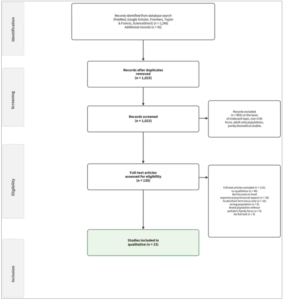
A PRISMA (Preferred Reporting Items for Systematic reviews and Meta-Analyses) flow diagram (Figure 1) is used for article screening and the selection process. Initially, a total of 1,248 records were found through database searches and an additional 42 records were found from other sources. After removal of duplicates, 1,023 records were screened; 893 were excluded at the title/abstract stage, leaving 130 full-text articles that were assessed for eligibility.
115 studies were excluded from the final pool of studies due to the following specific reasons: absence of qualitative data (n=46), not being focused on lived experience or psychosocial aspects (n=28), focused on only the short-term or acute states of CHD (n=16) or had no clear pediatric or family perspective (n=8) and or published in a non-English language or unable to retrieve full-text article (n=9). Ultimately, there were a total of 15 studies eligible for inclusion in the qualitative synthesis.
Figure 1: PRISMA flow diagram of study selection
CHD = congenital heart disease; PRISMA = Preferred Reporting Items for Systematic reviews and Meta-Analyses.
Output: Conceptual abstraction
The output will be a conceptual model or theory that will be more than a descriptive summary. It will integrate psychosocial adaptation, healthcare system interactions and long-term outcomes into a cohesive conceptual model that will provide new insights into family-centered care in CHD.
Results
Study characteristic table
The 15 studies shown in Table 3 are overwhelmingly qualitative in design.1–15 Nine of the included studies were purely qualitative (i.e. primary qualitative research), using various qualitative methodologies, such as a grounded theory approach (Rempel et al.), phenomenological approaches (i.e. interpretative phenomenological analysis) and other exploratory approaches that used qualitative methods.3 Three studies used mixed methodology by combining qualitative data with quantitative results. There were also three qualitative evidence syntheses, which consisted of two systematic reviews and one meta-synthesis, with the meta-synthesis method of qualitative analysis considered separately from the systematic reviews to reduce confusion, as this method is sometimes considered similar to systematic reviews.
Table 3: Characteristics of the studies included in the integrative synthesis1–15
| Study | Design | Population | Intervention | Outcomes |
| Eagleson et al.1 | Qualitative | Families of children with d-TGA | Long-term lived experiences | Psychosocial adaptation, coping and family burden |
| Callahan et al.2 | Mixed-methods | Parents of children with CHD | Parent-to-parent coping strategies | Coping, peer support and resilience |
| Rempel et al.3 | Grounded theory | Parents of young children with severe CHD | Parenting under pressure | Role adaptation, caregiving stress and coping strategies |
| Catapano et al.4 | Qualitative | Parents of neonates with CHD (ICU) | Intensive care experiences | Emotional distress, uncertainty and healthcare interaction |
| Chong et al.5 | Systematic review (qualitative) | Children with CHD and their families | Lived experience synthesis | Psychosocial challenges and quality of life |
| Dandy et al.6 | Meta-synthesis | Parents of children with CHD | Diagnosis experience | Emotional response, uncertainty and adaptation |
| Hsiao et al.7 | Qualitative | Adolescents with CHD and their parents | Parent–child relationship | Autonomy, relational dynamics and emotional adjustment |
| Ladak et al.8 | Mixed-methods (protocol) | Patients with CHD after surgery and their families | HRQoL assessment | Quality of life and psychosocial outcomes |
| Mitteregger et al.9 | Qualitative (exploratory) | Parents of children with CHD | Neuromotor development experience | Developmental concerns and parental stress |
| Murni et al.10 | Mixed-methods | Children with CHD and their caregivers | Delayed diagnosis | Healthcare system barriers and access issues |
| Lumsden et al.11 | Qualitative (IPA) | Parents of children with single-ventricle CHD | Lived parent experience | Identity, normalization and coping |
| Nayeri et al.12 | Qualitative | Parents of children with CHD | Meaning of caregiving | Emotional burden, adaptation and resilience |
| Nemes et al.13 | Qualitative | Parents and clinicians | Growing up with CHD | Healthcare system interaction and long-term care |
| Sprong et al.14 | Qualitative | Parents of children with critical CHD | Family-centered developmental care | Care needs, system gaps and developmental support |
| Svensson et al.15 | Systematic review (qualitative) | Families of children with CHD | Chronic illness experience | Long-term adaptation, coping and paradoxes |
CHD = congenital heart disease; d-TGA = dextro-transposition of the great arteries; HRQoL = health-related quality of life; ICU = intensive care unit; IPA = interpretative phenomenological analysi.
Methodological quality and limitations of the evidence base
The methodological appraisal confirmed that 14 of the 15 studies included were considered to be of high quality and 1 was of moderate quality. High-quality ratings were predominant but should be interpreted with caution. A high methodological rating does not imply that the set of studies included is comprehensive or free from important limitations in the evidence base; rather, it implies that the evidence base found in the included studies showed a high level of congruence between the research question, methodology, data collection, analysis, interpretation, ethical considerations and representation of participant perspectives. Limited reporting of researcher reflexivity was a common issue in the included studies. This issue was identified throughout the appraisal and indicated that methodological alignment was generally satisfactory but was inadequately described with regard to the influence of the researchers’ perspectives and relationships with participants. This is especially important when the research question involves an emotionally intense event or experience, such as parental distress, burden of caring, uncertainty or experiences with a healthcare professional in qualitative research. The high proportion of good-quality studies may also be due to the strict eligibility criteria that were used in this article. Studies had to include primary qualitative or significant qualitative evidence on the following areas: family experiences, psychosocial adaptation, healthcare encounters and extended care.
As a result, studies that reported solely quantitative findings, mostly acute clinical outcomes, showed a low focus on the family or pediatric perspective and/or did not provide complete-text qualitative findings were excluded. A lack of qualitative data, lack of lived experience/family/social focus, acute focus, absence of pediatric/child or family perspective and language/full-text access barriers were the main reasons for exclusion. The apparent methodological quality of the final evidence base, therefore, should not be taken as an indicator of the maturity of the CHD family literature as a whole. Instead, it suggests that the selected set of studies that fulfilled the specified qualitative and family-centered eligibility criteria were mostly well conducted.
There are significant limitations in the available longitudinal evidence, including the lack of representation of fathers and siblings, cross-cultural research, integration of clinical and psychosocial outcomes and assessment of family-centered interventions. These limitations are significant because qualitative studies can offer in-depth descriptions of lived experiences but cannot, on their own, reveal the prevalence, predictors or causal links to these experiences alone.
Multilevel thematic architecture
This synthesis presents a multidimensional framework for families experiencing CHD that integrates emotional distress, systemic challenges and the long-term effects of CHD on families.25,26 The framework reflects psychosocial adaptation to CHD, interactions with healthcare systems in navigating the complexities of this adapted behavior and the ‘long-term care trajectory’ of children with CHD as they move from a parent-centric model to one based primarily on the independence and self-responsibility of the child with CHD due to disease progression from acute to chronic management (Table 4).
Table 4: Multilevel thematic architecture illustrating psychosocial adaptation, healthcare interactions and long-term care trajectories among families of children with congenital heart disease
| Level | Theme | Key codes | Interpretation |
| Psychosocial adaptation | Emotional distress | Fear, anxiety, uncertainty | Initial and on-going psychological burden across the illness trajectory |
| Coping and resilience | Support, optimism, adaptation | Families develop strategies to sustain emotional stability | |
| Identity shift | Hypervigilance, caregiver role | Parents transition into specialized caregiving roles | |
| Family impact | Financial strain, lifestyle limits | CHD affects overall family functioning and quality of life | |
| Chronic anxiety | Future concerns, vigilance | Persistent stress due to the lifelong nature of the disease | |
| Healthcare system interaction | Fragmented care | Disconnection, poor coordination | Gaps in healthcare continuity burden families |
| Communication needs | Information gaps, decision support | Clear communication is essential for effective care navigation | |
| Care navigation role | Case management, advocacy | Parents act as coordinators within complex systems | |
| Access barriers | Socioeconomic and cultural factors | Inequities influence care access and outcomes | |
| Long-term care trajectories | Illness progression | Adjustment, chronic management | Shift from acute crisis to long-term care |
| Transition to adult care | Transition gap, discontinuity | Adolescents face risks during care transition | |
| Independence development | Autonomy, self-management | Gradual transfer of responsibility to the child | |
| Lifelong management | Adherence, monitoring | Continuous adaptation is required for long-term outcomes |
CHD = congenital heart disease.
Psychosocial adaptation dynamics
Families deal with considerable distress (shock, fear, anxiety and depression) related to diagnosis and surgeries. At the same time, they develop resilience and effective coping strategies, such as optimism, social support and a sense of coherence.17,27,28 This includes a transition from parent to hypervigilant caregiver. The risk of future complications and the lifelong nature of the disease can lead to chronic anxiety. The family unit often faces life restrictions, financial pressure and QoL issues. Other children can have emotional difficulties.
Familial recurrence and future-oriented anxiety
Parents’ psychosocial adjustment to CHD can also be affected by worries about recurrence in the family and doubts about future pregnancies. The diagnosis and treatment of one child with CHD may not be the end of the experience but may also lead to concerns about the possibility of CHD occurring in another pregnancy or in future children. These worries can lead to a sense of uncertainty, increased healthcare utilization and anticipatory anxiety. These concerns are especially applicable given that adjustment to the child’s current health state is not the only concern in family adaptation but also beliefs about future health, reproductive decisions and the likelihood of further health issues.26,29,30 Recurrence–related concerns should, therefore, be taken into account in the context of the wider psychosocial adaptation paradigm that was identified in this article.
Lingering anxiety and uncertainty due to post-complication effects are already significant aspects of the family experience, and uncertainty regarding familial recurrence may be another future-oriented aspect of this psychological burden.31 Further research is warranted regarding the possible interplay of recurrence fears, socioeconomic factors, specialist counseling and continuity of care. Families can be helped with information that is clear and appropriately communicated, as well as with longitudinal psychosocial support and information given at the time of the initial diagnosis, in this context.
These experiences can be further shaped by the broader socioeconomic context. In adults with CHD, evidence suggests that social and economic status is influential in long-term outcomes, highlighting the importance of socioeconomic status (SES) when considering CHD trajectories throughout the lifespan.32 It is important to note that this evidence does not provide direct proof of familial recurrence, but it strengthens the overall argument that social circumstances may influence the long-term experience and outcomes of CHD.
Patterns of family interaction with the healthcare system
There is a lack of continuity of care, especially after diagnosis, which can lead to disconnection and a need for better centralization. Timely and on-going communication with healthcare professionals is a critical element, particularly in terms of understanding the child and making medical decisions.13,33,34 Parents take on the role of case managers to support the system, coordinate appointments and manage school systems. Social and cultural factors play a major role in access to care, leading to stress and inequity in care.
Long-term care trajectories
This extends from the initial crisis to complex, lifelong care. This includes the transition gap from pediatric to adult care.35,36 As the child with CHD develops, parents need to transition from direct care to encouraging independence as the child takes over managing their own needs. The shift from parental to young person’s care and management (such as medication and symptoms) is critical to successful transition.18
Cross-domain integration
Poor communication, bureaucratic processes and lack of integrated care, for example, waiting for urgent surgeries or poor transition to adult care, exacerbate parental feelings of distress, anxiety and hopelessness and place considerable burden on families.1,37 Effective communication, responsiveness and empathy from healthcare providers, as well as early screening and peer support for parents, for instance, buffer the trauma, thereby allowing families to remain resilient and enabling parents to cope with the chronicity of the illness.
Parents with high resilience and coping strategies are more likely to seek and follow through with services and to advocate for their child.17 In contrast, high levels of distress over time can result in healthcare disengagement. As children transition from acute to chronic care, parenting roles evolve from active care and vigilance to support for independence and academic and developmental challenges.38 This can affect parents’ employment, finances and wellbeing.
Evidence gaps and appropriate future study designs
Several gaps have been identified that, based on the integrative synthesis, cannot be sufficiently filled with further cross–sectional qualitative research. The current evidence base is limited by the relative scarcity of longitudinal study designs that are able to track families through key developmental and clinical milestones. For future research, this would be a next step from describing individual experiences to examining changes in psychosocial adaptation, healthcare interactions and care trajectories over time.
First, there is a need for prospective longitudinal mixed-methods cohort studies to investigate changes in family distress, coping, resilience, engagement with the healthcare services and QoL from the time of diagnosis to childhood and adolescence. Repeated quantitative assessments may describe the change in psychological and QoL outcomes, while qualitative interviews may describe the reasons for this change and the family’s reactions to the significant events of the treatment.
Second, multicenter studies need to be carried out to determine whether there are differences in family experience based on the complexity of CHD, treatment intensity, socioeconomic factors, cultural factors and access to specialist services. Future research should establish whether the themes found in the current synthesis are generalizable or are more relevant to specific clinical or social settings.
Third, further research is needed that accounts for the broader family context and does not focus primarily on the mother. Comparative qualitative or mixed-methods designs with mothers, fathers, children and/or adolescents with CHD could help illuminate the experiences of the various family members in relation to caregiving responsibilities, uncertainty, communication and transition to independence.
Fourth, prospective studies are needed to explore the interface between pediatric and adult CHD care. These studies should track adolescents over time and measure readiness for transition, self-management, engagement in healthcare and psychological functioning before and after moving to adult services. This would enable researchers to identify factors that contribute to a successful or unsuccessful transition that can be modified.
Fifth, studies on interventions to establish whether the psychosocial and family-centered approaches identified in the literature are able to yield measurable outcomes are needed. Structured psychosocial screening, peer support programs, family-integrated care, transition programs and digital health interventions could be tested in routine CHD services in pragmatic and controlled intervention trials or implementation studies.
Finally, the connection between SES and family adaptation should be explored in future studies. Mixed-methods studies across multiple centers that include measures of SES, healthcare access, health literacy, psychological adaptation and family functioning may identify subgroups associated with a higher risk of disengagement or poorer long-term outcomes and could guide interventions to support these groups. All these efforts would contribute to building an evidence base by extending descriptive information about family experience to comparative, longitudinal and intervention-based studies. The present synthesis thus offers a description of what exists and offers a basis for deciding what kind of research designs would be most suitable for addressing further uncertainties.
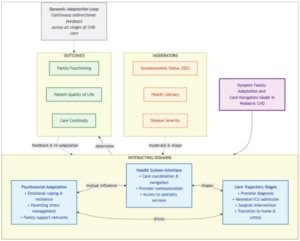
Conceptual model: Dynamic family adaptation and care navigation model
This framework depicts the process by which families adapt to the chronic, high-risk nature of pediatric CHD over time and seeks to transition from crisis to proactive care.
Interacting domains
Psychosocial Adaptation emphasizes the mental health, coping and emotional resilience of parents and siblings, including PTSD, anxiety and parental empowerment.30,39 It involves the process of shock, acceptance and adaptation. Health System Interface refers to the family–medical team relationship, focusing on communication, trust and decision-making. It includes the trend toward family-centered care and reducing the burden of care navigation. Care Trajectory Phases illustrate the evolving needs from pregnancy and severe infancy or surgery stages through childhood management and into adulthood (Figure 2).
Figure 2: Conceptual framework
CHD = congenital heart disease; ICU = intensive care unit
Moderators
SES impacts access to specialist services, practical supports and financial capacity to support chronic illness. Health Literacy affects parents’ understanding of complex heart conditions, communication with the healthcare team and home management. Severity of Disease affects hospital stay, the need for palliative care or intensive care and family stress levels.30
Outcomes
Family Functioning refers to the capacity of the family to remain stable, coherent and communicative, despite CHD. Patient QoL refers to holistic health outcomes such as neurodevelopmental outcomes, psychological adjustment and social acceptance. Care Continuity refers to continuity of care across acute, subacute and home settings and eventually from child to adult services to avoid care gaps.
Clinical and policy implications
Need for family-centered cardiology models
Implication: a shift from a strictly medical focus to a holistic model that acknowledges the family as the primary source of support is needed. This can be done by rooming-in, involving parents in decision-making and offering parents emotional support.24 Action: family-integrated care, whereby parents are included as part of the multidisciplinary team, thereby decreasing anxiety and increasing patient satisfaction.
Psychosocial screening in congenital heart disease care
Implication: Systematic assessment of psychological symptoms (anxiety, depression and PTSD) in children and parents, as parents focus on the child’s health.40 Action: the use of tools such as the Pediatric Symptom Checklist-17 during routine clinic visits to assess internalizing, externalizing and attention problems, so that early referral to a behavioral health specialist can occur.
Structured transition programs (pediatric–adult cardiology)
Implication: structured transition programs can reduce the high attrition rate and care gap associated with transition from pediatric to adult care by beginning these in early adolescence.41 Action: initiation of transition programs by 12–14 years of age to allow for a gradual transfer of responsibility from parents to the patient with the assistance of specialized transition nurses and clinics.
Multidisciplinary coordination strategies
Implication: a multidisciplinary approach can address the multifaceted nature of CHD (involving multiple organ systems) by enhancing communication between surgical, cardiology, nursing, psychological and neurodevelopment teams.41 Action: establishment of dedicated care pathways with on-going communication, such as a common electronic medical record and regular multidisciplinary team rounds to discuss patients with high acuity (for example, interstage monitoring).
Implications of digital health technologies for care navigation
Implication: digital health technologies can facilitate family management of complex care and increase access to information, particularly for rural or disadvantaged families.42 Action: creation or use of mobile apps, patient portals and 3D-printed heart models can improve parent knowledge, monitor milestones and allow for remote monitoring.
Future research directions
Future research is needed in CHD to understand the long-term effects on the family unit and harness new technologies to enhance QoL and psychosocial outcomes.43 The following are important future research directions. Research needs to focus on the interdependence of QoL among the family unit (parents, children and siblings) over time, especially following hospitalization, rather than solely on patient outcomes.
Dynamic tracking
Studies should include longitudinal measurement, such as assessments every 3 months for 1 year, to capture periods of family psychosocial adjustment and coping from the immediate post-discharge period through chronic management.44
Longitudinal data are needed to identify which variables – clinical, demographic or psychosocial – predict long-term family wellbeing. Research shows that cultural factors impact parental stress and family functioning. Researchers need to examine the impact of CHD across varying healthcare and cultural contexts to provide culturally appropriate support.45 It is important to assess the existing psychosocial care approaches in low- and middle-income countries to ensure that these approaches can be applied across varying resource contexts.
Future research should build and test interventions to enhance resilience, with interventions for both parents and children rather than education for only one group.46 There should be a shift in research toward the implementation and evaluation of integrated models of care that embed psychosocial support in standard cardiac care, as described in studies on a psychosocial care model for families affected by CHD.47 Care should be targeted at the transition from child to adult services to minimize anxiety, depression and nonadherence in adolescents.
Explicitly adding recurrence-related concerns and future-oriented uncertainty to the psychosocial assessment of families affected by CHD are also important areas for future research. Future studies might investigate the relationship between anxiety and use of healthcare services, reproductive decision-making, family functioning and/or concerns about recurrence and/or future cardiac complications. Mixed-methods designs that incorporate validated psychological assessments in addition to qualitative interviews would be most useful for better understanding the magnitude and pathways of these concerns and the ways in which families experience and navigate them. These experiences should be explored, and the roles of genetic counseling skills, communication, socioeconomic factors and access to specialist services should not be overlooked in such research.
Acknowledging the implications of the integrative synthesis
Collectively, these results point to the fact that the current knowledge problem in family-oriented CHD research is not just the absence of descriptions of psychosocial distress but the absence of evidence that explains how family experiences change and are related over time. The three domains that were identified in this article should not be seen as stand-alone outcomes. Engagement with healthcare resources may, in turn, affect family adaptation and the ability to manage long-term care. Conversely, engagement with healthcare resources may be influenced by psychosocial adaptation, whereas the quality and continuity of healthcare interactions may also be influenced by psychosocial adaptation. Likewise, other factors such as developmental changes, disease flares, changes in disease status or socioeconomic factors can change these relationships over time.
This interpretation allows a transition from the patient-centered and/or parent-focused interpretation of parental distress and/or patient QoL to a family-centered and/or longitudinal approach to the care of CHD. Future research studies should, therefore, combine clinical variables with psychosocial, family, healthcare system and socioeconomic variables. This would allow researchers to determine not only which families have problems but also when problems occur, how they are affected by certain factors and what interventions can help to prevent these problems from causing on-going distress or turning a family away from care.
Strengths and limitations
Strengths include an integrative, Theory-Building Synthesis by synthesizing findings from a variety of qualitative studies. This approach can be used to develop new themes or models, for example, to map the care process that individual studies cannot. Capturing the Lived Experience: this approach is good at capturing the subjective, emotional and everyday experiences of families. It goes beyond quantitative measures of distress to examine coping strategies. Revelations of Need: this approach reveals areas of care that need to be improved, such as the needs of minority families, transition from pediatric to adult care and the need for peer support.
Limitations include the Heterogeneity of Included Studies, because the studies included often address different topics, for instance, diagnosis before or after birth. These different types of heart defects, methods and cultures can be difficult to synthesize. Lack of Quantitative Validation: since this is a qualitative synthesis, the conclusions are not quantitative and predictive. Themes are not necessarily applicable to all groups and cannot offer exact, statistically verified percentages of outcomes. Even with the goal of long-term trajectories, many studies focus on the initial diagnosis and few have on-going data on the transition through adolescence and adulthood. Furthermore, the requirement to use only English-language and accessible full-text publications could have resulted in the exclusion of research from other languages and resource-poor environments, limiting the cultural and socioeconomic diversity of the evidence used.
Conclusion
Reframing CHD as a Family–centered Chronic Condition encompasses the lived experience of CHD, which extends beyond the child’s physical diagnosis to encompass the entire family unit’s psychological, social and financial wellbeing. Care providers must view CHD as a chronic condition that requires on-going management rather than discrete treatment and recognize QoL, not just death, as an outcome of interest. It is impossible to address the journey of adaptation without considering family-centered interventions, including psychosocial support for parents and siblings, to support families and improve longer-term outcomes for the child. Adaptation is Dynamic and System-Dependent: adaptation is not a one-off event but a dynamic process that varies over time according to the child’s developmental stage, timing of surgery and transitions (for example, transition to adult care). The nature of the parent–healthcare system relationship is the main driver of adaptation, with poor communication and coordination exacerbating stress, and shared care and support increasing resilience.
Parents adapt through protective scaffolding (vigilance, family life optimization and information seeking), which needs support and education. A Foundation for Next-Generation CHD Care Models offers a basis for proactive, decentralized care models such as Congenital Heart Disease Long-term Improvements in Functional hEalth (CHD LIFE), which can help overcome geographical and logistical challenges and improve equity. Future models need to extend beyond hospital care to include on-going multidisciplinary care (cardiology, psychology and nursing) to address the complex interaction of neurodevelopment, psychosocial and physical needs. This approach to incorporating lived experiences will better align with family values and priorities, facilitate self-management and establish a sustainable, empowering and compassionate care environment.


