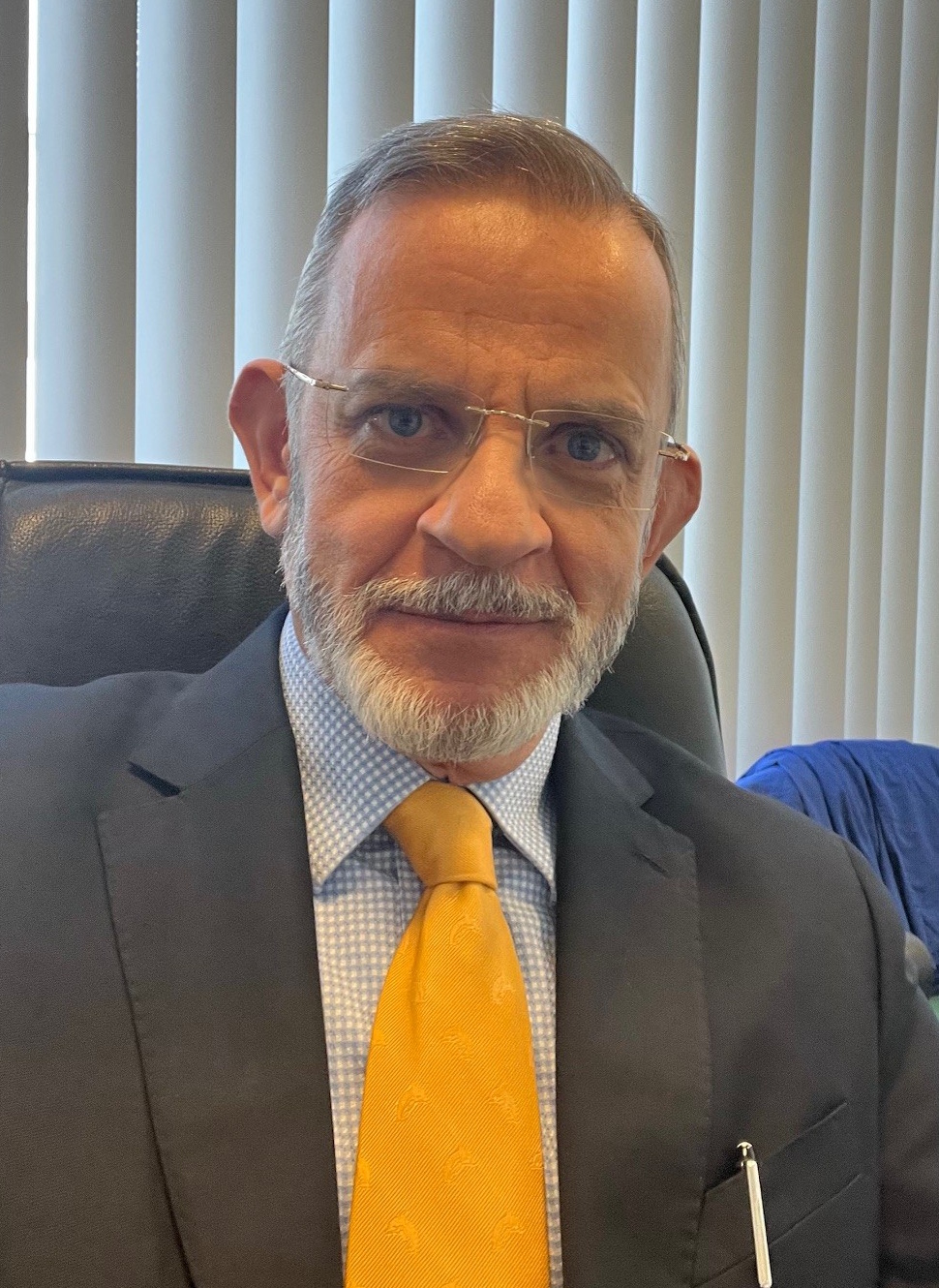
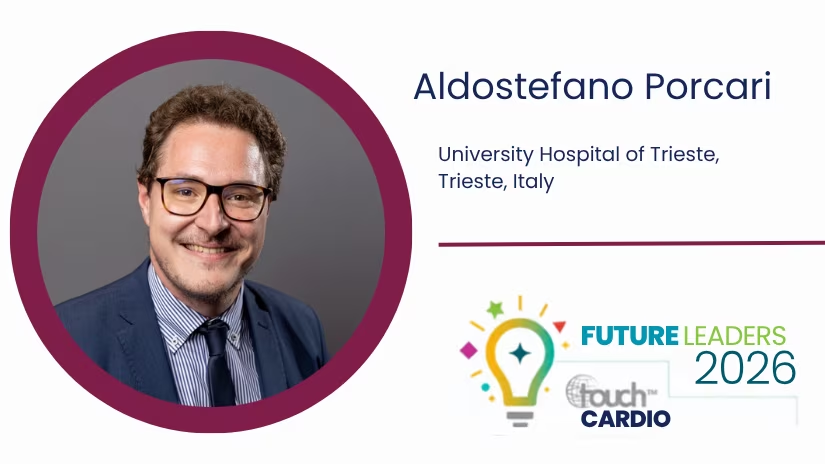
We are delighted to feature Dr Aldostefano Porcari as a touchCARDIO Future Leader 2026, recognized as an emerging leader in clinical cardiology.
New insights are added regularly, covering a broad range of subspecialties and evolving clinical scenarios. Sign up below for Free Access to the latest clinical updates in your specialty!
What inspired you to pursue your career originally in cardiology?
The person who first inspired me was one of my professors at medical school, at Università Campus Bio-Medico di Roma. Professor Sebastiano Costantino was trained in internal medicine and was one of the first physicians who really showed me what being a doctor could mean.
He could teach across very different areas of medicine – nephrology, cardiology, haematology – and seemed able to move naturally from one field to another. What fascinated me most was not simply how much he knew, but the way he reasoned and presented clinical problems. For a young medical student, that was incredibly appealing.
He also had a second specialty in cardiology, and whenever he taught cardiology there was something different. He had this ability to ignite the curiosity of the students.
After my third year, once I had taken his exam, I asked whether I could start following him on the ward. From my fourth year onwards, I spent time seeing patients with him and with the other doctors while I was still completing medical school.
That changed the way I studied. I was no longer studying simply to pass the next exam. I was studying because I wanted to understand more of what I was seeing on the ward and, within the limits of what a medical student could do, to become useful to patients and to the clinical team. It made my learning much more active and clinically oriented.
When I eventually finished medical school, the cardiologist supervising my thesis asked me what I wanted to do next. I told him I was still uncertain between internal medicine and cardiology. He immediately said, “No, you are made for clinical cardiology. That is what you should do.”
He also encouraged me to move for the next stage of my training. I come from Puglia, in the very south of Italy; I had moved to Rome for medical school, and then I moved all the way north to Trieste for cardiology training.
So I owe a great deal to the Università Campus Bio-Medico di Roma and to those early mentors. They not only introduced me to cardiology, they helped me understand what kind of doctor I wanted to become.
What really interests you about the clinical side of cardiology?
Well, there are several things.
During my final years of medical school, I deliberately spent some time in a non-university hospital because I wanted to understand what medicine looked like outside an academic or highly specialised referral environment. I went back to my hometown in southern Italy and spent one month in internal medicine and another in cardiology.
What I had always loved about internal medicine was the diagnostic process. A patient comes in with several problems, and the real question is not simply, “Does this patient have heart failure or kidney dysfunction?” The question is: why does this patient have that manifestation? How does that relate to the renal dysfunction, the pulmonary disease, or another apparently unrelated finding?
That was the part I found fascinating. You are constantly looking for the missing pieces of the puzzle, identifying inconsistencies in the clinical picture and asking whether apparently separate findings can actually be reconciled within one unifying hypothesis.
My first mentor taught me the beauty of difficult cases. You always have to ask yourself why. You need to generate one, two or three plausible hypotheses, test them, remain comfortable with uncertainty and be prepared for results that do not fit your original expectations.
I used to feel a little like a detective, and I never found that boring.
When I then spent time in cardiology, I realised that I could retain that depth of clinical reasoning while entering a field with an extraordinary range of diagnostic tools and a very strong evidence base. There were guidelines, clinical trials, imaging, haemodynamics, electrophysiology – an enormous amount of high-quality information that could help you make decisions for an individual patient. For me, that combination changed everything.
To be completely honest, I also spent a month in neurology, because that was another specialty I seriously considered. I have always enjoyed physical examination and reconstructing a diagnosis from symptoms and signs, and neurology is probably one of the purest expressions of that approach. If you are very good at examining a patient, you can often localise the problem with remarkable precision.
But in the end, I think cardiology won for two reasons.
The first was intellectual: there was an enormous body of evidence, but still plenty of room for clinical reasoning and interpretation.
The second was more emotional. I felt that I could make a very tangible difference to patients. I remember seeing people admitted with severe heart failure who could barely lie flat because they were so breathless, and then seeing them walk out of the hospital a few days later. As a young doctor, that was extraordinarily powerful.
I also realised that I was particularly attracted to the chronic side of cardiovascular medicine: heart failure, cardiomyopathies and imaging. I like understanding why a disease has developed, following people over time and trying to change the trajectory of their illness, rather than looking only at a single acute event.
What advice would you give to any young person that’s coming into this field to get fired up to see what they want to do next?
The first thing I would say is: be brave enough to speak up.
As a medical student or very young doctor, it is very easy to sit in a room thinking, “I am the youngest person here. I probably have nothing interesting to say. Everyone else knows much more than I do.”
Of course they know more: they have been doing the job for longer. But every senior doctor in that room was once the youngest person in the room.
So ask questions. Talk to people. Approach the physicians you admire. Say that you are interested. Ask whether you can shadow them, take part in a project or simply observe how they work. There is nothing unusual about being young and not yet knowing exactly where you are going. That is precisely the stage when you should explore.
The second piece of advice is perhaps even more important: know yourself.
Choosing a specialty is not only about identifying the most interesting disease or the most prestigious field. It is also about understanding your own personality, your strengths and the kind of professional life that will allow you to perform at your best.
For example, I gradually realised that I was not naturally drawn to specialties dominated by constant acute decision-making. I like having the time to look carefully at the information in front of me, think critically, speak to patients, understand who they are and follow them over time.
Human contact is also extremely important to me. I wanted a specialty in which the relationship with the patient could develop over years, not only minutes or hours.
Cardiology gave me an interesting balance. Of course, it contains highly acute situations — myocardial infarction, cardiogenic shock, life-threatening arrhythmias — but it also gives you very powerful tools to intervene in those situations. At the same time, it offers the chronic, intellectually complex side that I find particularly rewarding in heart failure, cardiomyopathies and cardiovascular imaging.
I like being able to gather the information myself, recognise the key findings and then connect the dots.
So I would tell young doctors: do not choose a specialty simply because you think you are supposed to adapt to it. Understand yourself first, and then find the specialty that fits the way you think, work and relate to people.
Where has this way of thinking taken you so far, and how has it shaped the doctor and researcher you are today?
I think this way of approaching medicine gradually led me towards cardiomyopathies and, eventually, cardiac amyloidosis.
It did not start because one day I decided that I wanted to become an amyloidosis specialist; it started from patients. During my cardiology training in Trieste, I became increasingly interested in people with heart failure and cardiomyopathies whose clinical picture did not completely fit the usual categories. There were often small inconsistencies — a finding, a symptom or an imaging feature that made you stop and ask whether there was something else behind the phenotype.
Trieste was fundamental in shaping the way I learned to approach those patients. Professor Gianfranco Sinagra taught me the importance of method and of being critically rigorous with data: to break down complex problems, organise the evidence, distinguish what we know from what we think we know, and apply the same logical discipline in clinical medicine and research. One lesson from him that has stayed with me is that method does not constrain intuition; it gives intuition a structure, so that an idea can be tested, challenged and eventually transferred to other patients.
Professor Claudio Rapezzi taught me something different but very complementary: the value of curiosity and of remaining capable of being surprised. If something in a patient does not fit, you should not necessarily dismiss it as noise. Sometimes that discrepancy is exactly where the diagnosis begins. In many ways, Sinagra and Rapezzi gave me two complementary ways of thinking: rigour in the method, but freedom and curiosity in asking the question.
That curiosity eventually took me to London.
I undertook a PhD in Amyloidosis at University College London and the National Amyloidosis Centre, working with Professor Marianna Fontana, Professor Julian Gillmore and Professor Philip Hawkins.
It was one of the most transformative experiences of my career. There is a big difference between reading the literature on a disease and working every day with people who have seen thousands of patients with that disease. You begin to appreciate nuances that are very difficult to learn from a paper alone. At the same time, I was given the opportunity to develop questions of my own, lead research projects and understand what it means to take an observation from the bedside, turn it into a research question and eventually produce evidence that may influence clinical practice. That transition — from contributing to research to taking responsibility for an idea — was a very important part of my development.
Some of the things that followed are things I would never have imagined when I was a medical student. My research has been recognised by major cardiovascular organisations on both sides of the Atlantic, including the American Heart Association (AHA), the American College of Cardiology (ACC) and the European Society of Cardiology (ESC).
More recently, receiving the Business Care International Award as a Rising Star had a particularly personal meaning. The award was created by Massimo Veccia to recognise Italian professionals with an international dimension and to celebrate connections across countries, disciplines and cultures. That vision resonates strongly with my own journey: being trained in Italy, growing scientifically through experiences abroad and trying to bring those worlds together rather than seeing them as separate.
To me, the real meaning of these awards is that an observation made at the bedside in Trieste, or a question developed during a discussion in London, can travel much further than the place where it originated.
Moving abroad was equally important on a personal level. It forces you to test yourself in a different healthcare system, academic culture and way of thinking. You meet people who become collaborators, mentors and close friends. Early in your career, it is easy to think in terms of my paper, my project, my result. Eventually you realise that science is much larger than any individual researcher. You are contributing to a global conversation in which people you may never meet can influence the way you think, and your work may in turn influence theirs. All this is extraordinarily powerful.
Eventually, I decided to return to Italy because I wanted to bring back what I had learned and translate that experience into clinical practice and research at home, while remaining connected to the international networks that had shaped me.
And perhaps this is where everything comes together for me today. One of the most rewarding aspects of my daily work is being able to give patients with amyloidosis answers that only a few years ago we often did not have – whether that means offering a treatment that would previously not have been considered, defining a clinical pathway that did not really exist before, or being able to discuss the risk of an event that we once thought could not be meaningfully quantified for an individual patient.
What makes this especially powerful is that some of those answers come from research questions that began with patients I had seen myself. There is something very special about seeing an idea that started at the bedside return to the bedside in a more mature form and actually change what you can offer to the person sitting in front of you.
For me, that is probably the most tangible meaning of clinical research: not producing knowledge as an abstract exercise, but creating evidence that helps you make a better decision, explain uncertainty more clearly, identify risk more precisely and, ultimately, change the trajectory of a patient’s care.
I think that is where I feel most comfortable today: clinically rooted in one place, but scientifically connected to a much larger community. And perhaps the most rewarding part is knowing that the journey is still very much in progress.
touchCARDIO is celebrating the brightest rising stars in the cardiology community, who are set to shape the future of the field.
See the full list of touchCARDIO Future Leaders 2026 winners here.
More content in cardiovascular disease
Cite: Dr Aldostefano Porcari on clinical cardiology: touchCARDIO Future Leader 2026. touchCARDIO. October 2026.
Disclosures: Dr Aldostefano Porcari is on advisory boards for AstraZeneca, has received honoraria from Alnylam, Bayer and Pfizer and has participated on speaker’s bureau with Alnylam. This short article was prepared by touchCARDIO in collaboration with Dr Aldostefano Porcari. No fees or funding were associated with its publication.
Editor: Heather Hall, Managing Editor