We are delighted to feature Dr Faisal Rahman as a touchCARDIO Future Leader 2026, recognized as an emerging leader in interventional and structural cardiology.
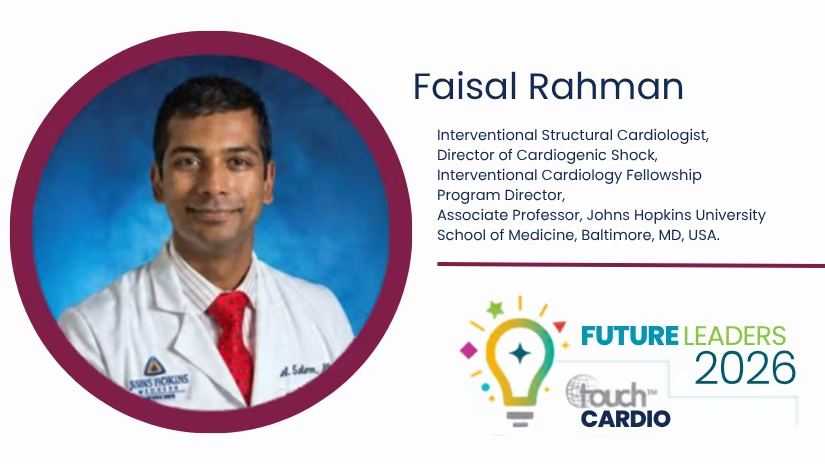
As part of the touchCARDIO Future Leaders series, we are pleased to feature Dr Faisal Rahman, an Interventional Structural Cardiologist, Director of Cardiogenic Shock, and Interventional Cardiology Fellowship Program Director at Johns Hopkins University School of Medicine in Baltimore, MD, USA. An Associate Professor at Johns Hopkins, Dr Rahman is recognised for his leadership in interventional cardiology, particularly in the management of cardiogenic shock and structural heart disease. He has authored more than 40 peer-reviewed manuscripts and is actively involved in more than eight randomised controlled trials. His contributions to the field have also been recognised through his selection as one of Cardiovascular Business’s 40 Under 40.
As a clinician, researcher and educator, Dr Rahman is committed to advancing the care of patients with complex cardiovascular disease while supporting the development of the next generation of interventional cardiologists. In this interview, he discusses his journey in interventional cardiology, the experiences that have shaped his approach to leadership, the evolving landscape of cardiogenic shock and structural heart disease, and the importance of mentorship, research and education in building a career in cardiovascular medicine.
New insights are added regularly, covering a broad range of subspecialties and evolving clinical scenarios. Sign up below for Free Access to the latest clinical updates in your specialty!
What inspired you to pursue a career in cardiology?
My first exposure was personal: both of my maternal grandparents had suffered myocardial infarctions and heart failure. However, my interest really grew during medical school and internal medicine residency, when I started to appreciate how much cardiology asks of you at once by combining physiology, imaging and a coordinated way of reasoning through a disease that often requires consideration of the multi-organ human. I also like using my hands, and interventional and structural cardiology let me do that without not only giving up any of the rest, but really further augmenting my ability to think in an integrated way that involved multiple modalities and complex problems.
Who has been the most significant mentor or role model for you, and what did you learn from them?
I have been very lucky to have amazing mentors who continue to guide and support me. In medical school, Dr Helen Christian was an inspiration and set the tone with her breadth of knowledge, her empathy and the way she approached research and new discovery. In residency, my program director Dr Gopal Yadavalli, and my research mentor, Dr Emelia Benjamin, showed me where the joy in this field lives: what it means to integrate the multi-faceted nature of cardiology to develop the solutions of care and the rewarding nature of discovery through research. During cardiology training Dr Steve Schulman and Dr Jon Resar continued to help me strengthen in these areas and helped me learn how to work through hard problems and develop ideas of my own ideas.
My biggest role models are my parents, Taufiqur and Deena Rahman, because they are two people who are never willing to give up, always hard-working, always loving and caring towards everyone, which showed me how rewarding it is to have those characteristics.
What has been the most rewarding moment in your journey so far?
Three kinds of moments stand out. The first is when I am able to take care of patients, some of whom have been declined by other centers, that I am able to help and seeing them on the other side of the treatment feeling and doing much better. I recently treated a patient with severe tricuspid regurgitation who had been declined by other major centers and is doing remarkably well on follow-up since we performed his transcatheter tricuspid valve replacement.
The second is watching seeing my trainees achieve great things. One of my recent fellows is treating patients and breaking barriers doing procedures that had never been done at his center before.
The third is changing something at the level of the system or through research, so the benefits reach patients I will never meet. Building the Cardiogenic Shock program and my other systems based work falls within the category.
touchCARDIO is celebrating the brightest rising stars in the cardiology community, who are set to shape the future of the field.
See the full list of touchCARDIO Future Leaders 2026 winners here.
More content in interventional cardiology
Cite: Dr Faisal Rahman on research, mentorship and cardiology: touchCARDIO Future Leader 2026. touchCARDIO. October 2026.
Disclosures: This short article was prepared by touchCARDIO in collaboration with Dr Faisal Rahman. No fees or funding were associated with its publication.
Editor: Heather Hall, Managing Editor