We are delighted to feature Dr Vijay Shyam-Sundar as a touchCARDIO Future Leader 2026, recognized as an emerging leader in clinical cardiology.
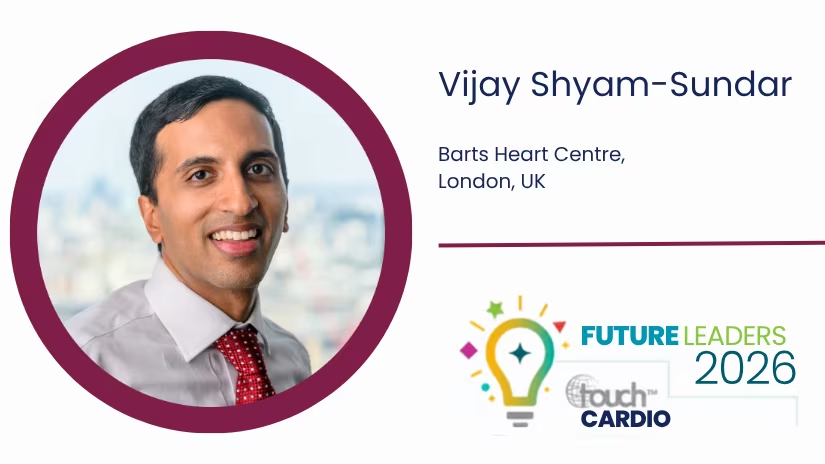
As part of the touchCARDIO Future Leaders 2026 series, we are pleased to feature Dr Vijay Shyam-Sundar, a cardiologist at Barts Heart Centre and King’s College London, London, UK. He studied Medicine at the University of Cambridge. He began his cardiology career in London in 2019, pursuing academic cardiology and medical training followed by doctoral research at Queen Mary University of London. He is currently working as a NHS Fellow in Clinical AI alongside clinical training in interventional cardiology.
In this interview, Dr Vijay Shyam-Sundar discusses his journey in cardiology, the mentors who inspired his career in clinical academia and the challenges of securing research funding and driving change in healthcare. He also explores his work using AI to improve cardiovascular care and its potential to transform clinical practice and empower patients, and the importance of safety and understanding the limitations of these emerging technologies.
New insights are added regularly, covering a broad range of subspecialties and evolving clinical scenarios. Sign up below for Free Access to the latest clinical updates in your specialty!
What inspired you to pursue a career in cardiology?
I think the main motivation to pursue this field really was guided by what I saw in clinical practice. I thought, this is a dynamic speciality with an evidence base that informs decisions in patient care. Additionally, I like the acuity of the work and the ability to be able to shape the patient’s journey by investigating and then treating. I guess I like to be involved in all aspects of patient’s care from first presentation all the way through to their discharge and outpatient follow-up. I think that’s really what attracted me because there are few areas in medicine that can offer that overall or overarching view, if you like, of patient care that you can get in cardiology.
Can you tell us about a mentor who has had a significant impact on your career?
I’ve been fortunate to have multiple mentors at different stages; I think the clinicians are the people that really have guided me and led me to who I am today.
However, if I was to pick one person, it would probably have to be somebody from my most recent journey, which was completing my doctoral thesis and that would be one of my supervisors, Dr Nay Aung. He is an exceptional academic, a brilliant clinician, and he’s that rare combination of being able to truly capture where the gaps lie in cardiology and then being able to investigate and test his hypotheses. In that regard, I have many inspiring research mentors, other supervisors as well, but I think he’s the person I would say that’s really inspired me to continue to pursue clinical academia going forward.
I would like to thank my funder, Bart’s Charity, and additionally, my current funders, the NHS Fellowship in Clinical AI, for whom I’m indebted to for the opportunity to work alongside my hospital practice on an immersive AI project. I want to thank all my mentors, my research supervisors and all my clinical colleagues for their words of support and guidance throughout my career. I am who I am today because of them, essentially.
What have been the most significant challenges in your journey so far, and how have you overcome them?
I think the major challenge that I’ve had to face in the last five years, I would say, is securing funding for research. I think this is a battle that many academics and clinicians face, and has been something that’s taught me a lot about writing, peer review, crafting your idea and the importance of having very clear hypotheses and objectives at the outset.
On a broader front, I think one of the difficulties my colleagues and I face is resistance to change. That is something that I continually work on myself, thinking about how to bring about change and how to bring clinicians and researchers alike along with me when I propose ideas or we propose to do things both in the research domain and in clinical practice.
Can you tell us about what you’re working on at the moment?
The training path in Cardiology is long and challenging, but there’ve been many highlights. It has been fascinating and satisfying to work on a machine learning project in cardiology during my doctoral research, and now work as a clinician AI scientist following the completion of my PhD.
Currently what I’m working on is implementation of artificial intelligence (AI) in healthcare. My project involves using and harnessing the power of the electronic health record to improve patient outcomes in cardiology. What I’m specifically focusing on is risk prediction for patients with coronary artery disease, identifying those who are highest at risk, and then trying to target patient pathways to improve the care of these patients.
What current development or trend in your specialty excites you the most?
I think it has to be AI. I mean, I’m sure many others share these sentiments, and I know people in my group and elsewhere are working on integrating AI into every aspect of the research workflow. I think the more exciting prospect is being able to use artificial intelligence in the clinic, and that’s why it’s really satisfying for me to be able to work on something in the hospital environment. I foresee that actually beyond the clinic, it’s going to empower the patients as well. I think that’s really fantastic for us, because the reality is clinicians have too little time to spend with their patients and anything that can empower and democratize information and explanation, I think will help all the stakeholders involved in this process, whether that’s academics, clinicians, patients, management and the very hardworking administrative staff as well. So I think all the stakeholders can benefit from this.
I think the challenge for us is to engage with the technology, understand its limits and its pitfalls, and to try and stay ahead of the next development, because the pace of change is rapid. I think if you look at the literature, you can see that this has been reflected in the number of publications that probably mentioned the words “AI” in depth. That’s something I’m really excited about, but I also share the same scepticism that I had when I began my research in this field, that it has the potential to do a great deal of harm as well to our patients. I think it is very important as clinicians, as academics and the wider community, in trying to understand how to evaluate these technologies and how to ensure that what is deployed and what is used by our patients and our clinicians is safe. That’s something that I’m really passionate about (trying to maintain safety in AI and healthcare) and that’s what I look to incorporate into my roles in the future.
What do you think the future holds for you and the cardiology community?
I’m passionate about trying to explain these emerging health technologies to the wider medical community, cardiologists and patients. I think that we’re all going to be using AI daily, and for me, explainable AI is an important part of how we use these technologies effectively and safely. Understanding how AI works in healthcare and the limits of these tools in the clinic is vital, and hospitals and regulators are increasingly adapting to the ever-changing landscape of clinical AI.
touchCARDIO is celebrating the brightest rising stars in the cardiology community, who are set to shape the future of the field.
See the full list of touchCARDIO Future Leaders 2026 winners here.
More content in interventional cardiology
Cite: Dr Vijay Shyam-Sundar on artificial intelligence and clinical cardiology: touchCARDIO Future Leader 2026. touchCARDIO. October 2026.
Disclosures: This short article was prepared by touchCARDIO in collaboration with Dr Vijay Shyam-Sundar. No fees or funding were associated with its publication.
Editor: Heather Hall, Managing Editor