This website is intended for healthcare professionals only

Trending Topic

31 mins

Trending Topic

Developed by Touch
Mark CompleteCompleted
BookmarkBookmarked

Ventricular fibrillation (VF) is characterized by rapid (>300 beats a per minute), irregular electrical activation with variable electrocardiographic waveforms that prevents coordinated myocardial contraction, resulting in immediate loss of cardiac output.1 It most commonly occurs in the context of coronary artery disease.2,3 Resuscitation efforts are critically time-dependent: with each minute of untreated VF, the survival rate declines […]

31/Involuntary arm movements post-pacemaker insertion: Real or Reel syndrome?

H Willis (Presenting Author) – Northwick Park Hospital, London, UK; JR Griffiths – Glenfield Hospital Leicester, Leicester, UK; S Hussain – Glenfield Hospital Leicester, Leicester, UK; R Somani – Glenfield Hospital Leicester, Leicester, UK
< 1 min
Share
Facebook
X (formerly Twitter)
LinkedIn
Via Email
Mark CompleteCompleted
BookmarkBookmarked
Copy LinkLink Copied
Published Online: Oct 8th 2020 European Journal of Arrhythmia & Electrophysiology. 2023;9(Suppl. 1):abstr31
Select a Section…
1

Article

Background: Twiddler syndrome, and the variant Reel syndrome, are rare but important complications of pacemaker implantation.

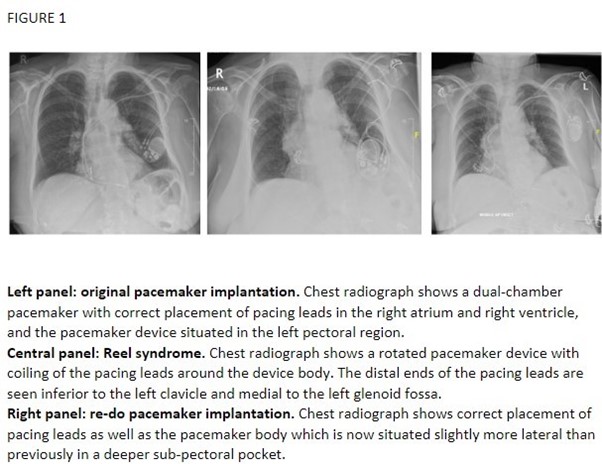
Case summary: We describe a rare complication of conventional permanent pacemaker implantation of rhythmic arm twitching secondary to brachial plexus stimulation from a displaced pacing lead caused by Reel syndrome.

Discussion: Twiddler syndrome and its variants are rare but important complications of pacemaker insertion. Holistic planning of cardiac procedures in elderly patients should identify those at risk to allow for targeted education and post-procedural care.

Conclusions: The pacemaker and the displaced leads were removed and replaced, with the pacemaker device being placed in a sub-pectoral pocket and correct placement of the pacing leads confirmed by chest radiography. This case provides excellent images of Reel syndrome seen on a chest radiograph (Figure 1), and highlight the benefits of holistic planning of cardiac procedures in elderly patients, as well as the importance of considering pacemaker lead displacement as a cause of left-sided abnormal movements. 

Figure 1: Calculated aortic and pulmonary artery pressures, as well as stroke volume, during a simulated change in programming for 20 seconds followed by reversion back to baseline

2

Further Resources

Share
Facebook
X (formerly Twitter)
LinkedIn
Via Email
Mark CompleteCompleted
BookmarkBookmarked
Copy LinkLink Copied
Close Popup