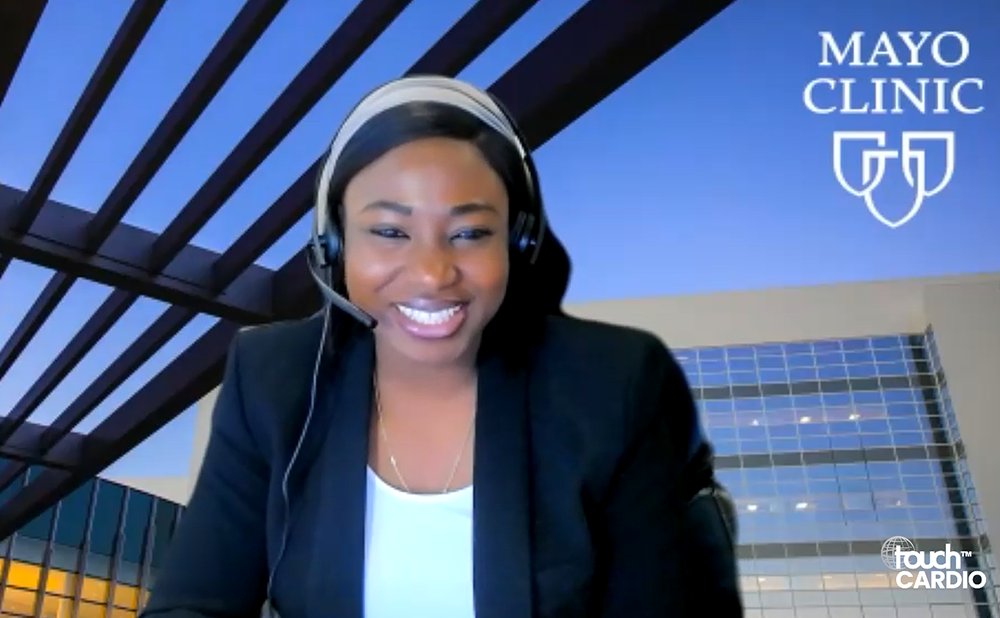
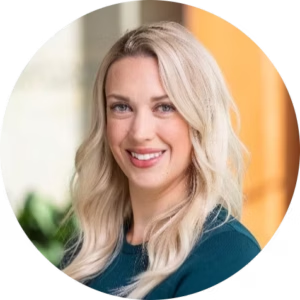
 We at touchCARDIO are delighted to welcome Dr Courtney Bennett, vice chair for the Division of Critical Care Cardiology, Senior Associate Consultant in the Department of Cardiovascular Medicine and Associate Professor at the Mayo Clinic School of Medicine and Science, Mayo Clinic, Rochester, MN, USA as one of our touchCARDIO Future Leaders 2025. Dr Bennett is a critical care cardiologist and echocardiographer and is interested in point-of-care ultrasound and the role of echo in critical care, as well as quality improvement and program building in the areas of acute coronary syndrome and cardiogenic shock.
In this Q&A, Dr Bennett shares how life-saving moments in the cardiac intensive care unit, the privilege of patient partnerships and the promise of artificial intelligence (AI)-driven care have shaped a career devoted to healing hearts and advancing critical care cardiology.
Q. What inspired you to pursue a career in your specialty?
My decision to specialize in cardiovascular medicine was shaped during my cardiology elective in medical school. I was deeply impressed by the expertise with which cardiologists manage acute medical emergencies, such as myocardial infarction for which they swiftly transferred patients to the Cardiac Catheterization Laboratory to restore coronary perfusion and save their life. The comprehensive post-event management, including evidence-based therapies and advanced diagnostic modalities like echocardiography, further influenced my interest. Cardiology remains a dynamic specialty, with rapid advancements essential to addressing cardiovascular disease, which continues to be a leading cause of mortality worldwide.
Q. How has working with patients shaped your approach to medicine?
I am sincerely appreciative of the ways in which my patients have influenced my development as both a physician and an individual. My clinical experience has enabled me to interact with individuals from various cultures and backgrounds, deepening my understanding of how these factors affect health outcomes. I have gained valuable skills in integrating patient values into shared decision-making and identifying disparities that influence health. It is important for my patients to know that our relationship is a collaborative partnership, rather than one based solely on prescriptive textbook knowledge.
Q. What has been the most rewarding moment in your journey so far?
The most rewarding part of my career is the opportunity to take a patient suffering from critical illness on the scariest day or days of their life in the Cardiac Intensive Care Unit and provide the care that will get them back to the people and things that they love the most. I have a card from a patient who was admitted to the CICU with cardiogenic shock and severe coronary artery disease. There were many discussions with him and his family about the severity of his illness and high mortality. I coordinated his care and was able to get him home for destination therapy. A year later, he sent me a letter that described all the beautiful life he was living and credited me for giving him the opportunity to get there. I occasionally take that letter out and read it when I need a reminder of why I do this.
Q. What advice would you give to medical students or young professionals considering a career in cardiology and critical care?
Both cardiology and critical care are demanding specialties that require significant time commitment and dedication. However, the professional fulfillment derived from caring for patients is even greater. Critical care cardiology exemplifies collaborative teamwork, which is a particularly rewarding aspect of the field. While there are inevitably difficult days, including the loss of patients despite our best efforts, the support among colleagues remains strong. Many of my most rewarding experiences have occurred while working with a multidisciplinary team in the CICU, united in the shared goal of improving patient outcomes.
Q. Looking ahead, what do you anticipate will be the biggest advancements or changes in your field over the next decade?
Machine learning and artificial intelligence are on the horizon of critical care cardiology. It will not be long before we are able to consistently identify deteriorating patients before they develop the end-organ damage that significantly increases their mortality. These tools are already being researched and incorporated into care algorithms.
Citation: Courtney Bennett. Q&A with Dr Courtney Bennett: touchCARDIO Future Leader 2025. touchCARDIO. 4 August 2025.
Disclosures: This short article was prepared by touchCARDIO in collaboration with Dr Courtney Bennett. No fees or funding were associated with its publication.
 touchCARDIO is celebrating the brightest rising stars in the cardiology community, who are set to shape the future of the field.
Read more about touchCARDIO Future Leaders 2025 here.
Register now to receive the touchCARDIO newsletter!
Don’t miss out on hearing about our latest peer reviewed articles, expert opinions, conference news, podcasts and more.