This website is intended for healthcare professionals only

Dr Arunashis Sau on electrophysiology and AI: touchCARDIO Future Leader 2026

Arunashis Sau
4 mins
Share
Facebook
X (formerly Twitter)
LinkedIn
Via Email
Mark CompleteCompleted
BookmarkBookmarked
Copy LinkLink Copied
Published Online: Oct 26th 2026

We are delighted to feature Dr Arunashis Sau as a touchCARDIO Future Leader 2026, recognized as an emerging leader in clinical cardiology.
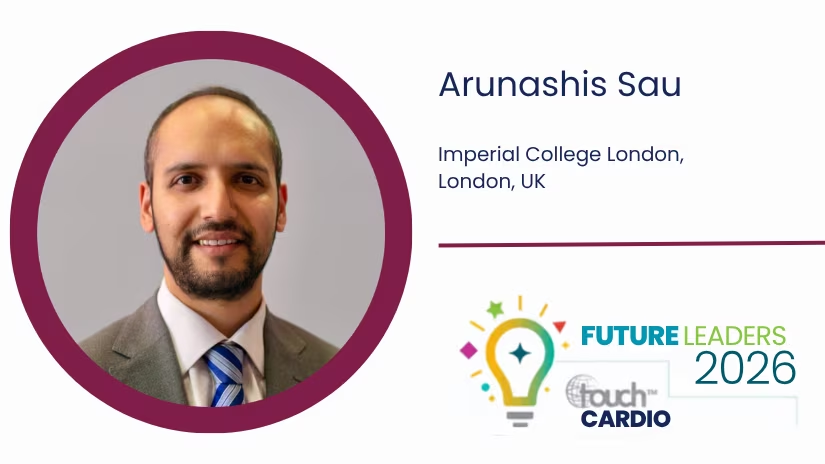
As part of the touchCARDIO Future Leaders 2026 series, we are pleased to introduce Dr Arunashis Sau from Imperial College London, London, UK. Dr Sau is Cardiologist and Electrophysiologist, British Heart Foundation Clinical Future Leaders Fellow and Clinical Lecturer at the National Heart and Lung Institute, Imperial College London. His research applies artificial intelligence (AI) to cardiology, in particular AI-enhanced electrocardiography (AI-ECG), which identifies patterns in the ECG that are not visible to the human eye and that predict cardiovascular disease, arrhythmias and patient outcomes. His pioneering work, including the AIRE (AI-ECG Risk Estimation) platform, has shown that the routine ECG carries substantial prognostic information. He received the British Cardiovascular Society Young Investigator Award in 2023 for this work. In 2026, he was awarded a £1.7 million British Heart Foundation Clinical Future Leaders Fellowship to develop AI that integrates multiple clinical data sources to improve the diagnosis and management of heart rhythm disorders. He is also co-founder and Chief Scientific Officer of Cardiovolt.ai, an Imperial spinout commercialising AI-ECG technologies, and has authored more than 70 scientific publications.

In this interview, he discusses his journey into electrophysiology, the mentors who shaped his career, the challenges of combining clinical training with research and learning AI from scratch, and his work developing AI tools that harness information from the ECG and other clinical data. He also explores the potential of multimodal AI to transform electrophysiology and the importance of prospective evaluation and safe implementation in clinical practice.

New insights are added regularly, covering a broad range of subspecialties and evolving clinical scenarios. Sign up below for Free Access to the latest clinical updates in your specialty!


What inspired you to pursue a career in cardiology?

Fittingly, it was the ECG that first drew me to cardiology. As a medical student and junior doctor I was fascinated that a cheap, 10-second recording could tell us so much about the heart, from its rhythm to whether someone was having a heart attack, and that reading it well was a skill you could keep improving over a whole career. That interest led me to electrophysiology, which combines hands-on procedural work, such as ablation and device implantation, with careful interpretation of the electrical signals recorded inside the heart. The same curiosity shaped my research. It became clear to me that clinicians use only a small fraction of the information an ECG contains. During the pandemic, I taught myself to code and started asking whether AI could pick out patterns we can’t see by eye and use them to detect hidden disease and predict outcomes.

Can you tell us about a mentor who has had a significant impact on your career?

Professor Fu Siong Ng at Imperial has had the biggest influence on my career. I joined his group in 2020 as a clinician with an interest in atrial fibrillation. He gave me the freedom to follow an idea quite far from where I started, and the backing to turn it into a programme of work. When I came across a large ECG dataset in a Nature Communications paper and emailed the authors, he encouraged me to pursue the collaboration. That work became the basis of the AI-ECG Risk Estimation (AIRE) platform. He has been generous with his time and honest in his feedback. I have also had valuable advice from many colleagues at the National Heart and Lung Institute and from collaborators around the world, and I try to offer the same openness to the students I now supervise.

What have been the most significant challenges in your journey so far, and how have you overcome them?

The most persistent challenge has been combining research with clinical training. Electrophysiology training is demanding, and protecting time for research takes deliberate planning and a supportive department. Academic training posts and fellowship funding have made this possible. Moving into AI as a clinician was a challenge in itself. I had to learn programming and machine learning largely from scratch, and the early stages involved a lot of self-directed learning and trial and error. What helped most was learning to start from a good clinical question rather than chase technical novelty.

What current development or trend in your specialty excites you the most?
I’m most excited by the move from single-test AI models to systems that combine several types of data. Much of the information about a patient sits in the ECG, imaging, electronic health records and the free-text notes clinicians write, but we rarely bring it together for the individual. Large language models now make it realistic to use unstructured clinical text at scale, and foundation models trained on large datasets can be adapted to many tasks with relatively little labelled data. In electrophysiology, combining the surface ECG with imaging and the signals we record inside the heart during procedures could change how we plan and perform procedures. The step that matters most comes after development: testing these tools in prospective studies and getting them into routine care.

touchCARDIO is celebrating the brightest rising stars in the cardiology community, who are set to shape the future of the field.

See the full list of touchCARDIO Future Leaders 2026 winners here.

More content in interventional cardiology

Cite: Dr Arunashis Sau on electrophysiology and AI: touchCARDIO Future Leader 2026. touchCARDIO. October 2026.

Disclosures: Dr Arunashis Sau has received grant/research support from the British Heart Foundation and has major stock/is a shareholder in Cardiovolt.ai Limited, along with other financial or material support. This short article was prepared by touchCARDIO in collaboration with Dr Arunashis Sau. No fees or funding were associated with its publication.

Editor: Heather Hall, Managing Editor


Share
Facebook
X (formerly Twitter)
LinkedIn
Via Email
Mark CompleteCompleted
BookmarkBookmarked
Copy LinkLink Copied
Close Popup