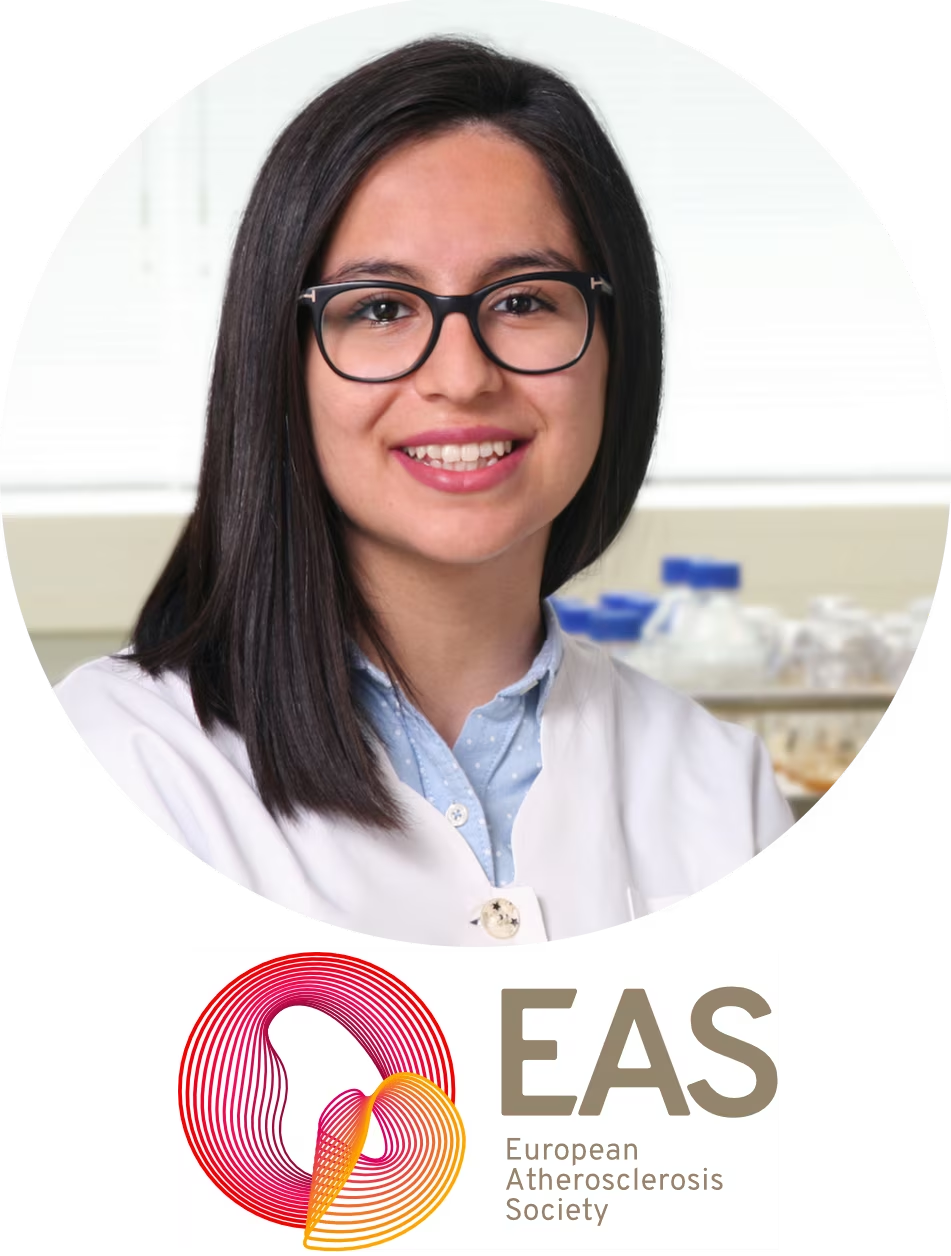
We are delighted to introduce touchCARDIO Future Leader 2025, Dr Azin Kheirkhah, a cardiovascular epidemiology researcher at the Institute of Genetic Epidemiology, Medical University of Innsbruck, Innsbruck, Austria with a primary focus on cardiovascular epidemiology. Nominated as a touchCARDIO Future Leader 2025 in collaboration with the European Atherosclerosis Society, she earned her PhD with a research focus on the role of PCSK9 and its association with cardiovascular and chronic kidney diseases.
Dr Kheirkhah holds a Bachelor of Science in Biomedical Sciences from King’s College London and a Master of Science in Immunology from Imperial College London. She is a European Atherosclerosis Society (EAS) Young Fellow Alumna and an active member of the Austrian Atherosclerosis Society.
Passionate about science communication, Dr Kheirkhah founded the AtheroTalk Podcast, supported by the EAS, where she and other EAS Young Fellows engage with experts to discuss developments in atherosclerosis research and clinical practice. She is also involved in the data management of the Austrian Familial Hypercholesterolemia Registry, contributing to the improvement of national cardiovascular health initiatives.
In this Q&A, Dr Kheirkhah shares how her winding academic journey led her to a passion for atherosclerosis, the impact of collaborative mentorship, and her excitement for how big data, multi-omics and machine learning are reshaping cardiovascular risk prediction and disease prevention.
Q. What inspired you to pursue a career in your specialty?
Unlike those who have known from childhood exactly what they want to do, I’ve always struggled with that decision. I remember how difficult it was for me in high school to choose a path. At one point, I was preparing to study architecture, until I realized I was much stronger in biology.
What I’m trying to say is that my journey hasn’t been linear. It wasn’t until I began my undergraduate degree at King’s College London that I felt I had finally found the right direction. I was genuinely happy to have chosen biomedical sciences, thanks in large part to the encouragement of my parents. I was surrounded by brilliant students, inspiring lecturers and leading researchers. Every course was fascinating, but I was especially drawn to cancer biology, vascular physiology and immunology.
I completed my bachelor’s thesis in an immunology department, which motivated me to pursue a Master’s degree in Immunology at Imperial College London. During that time, I discovered my strongest interest lay at the intersection of cardiovascular science and immunology; in particular, atherosclerosis emerged as the area I was most passionate about. This realization ultimately inspired me to pursue a PhD focused on this field.
Q. Can you tell us about a mentor who has had a significant impact on your career, and the most valuable lesson they have shared with you?
It’s hard to name just one mentor, as I’ve been influenced by different individuals at various stages of my life. Early on, my family shaped how I think and approach problems. In high school, a biology teacher made a lasting impression by encouraging us to always begin any explanation with four key questions: where? When? How? And why? That simple yet structured approach helped me navigate complex ideas and stay grounded in my understanding of science.
One particularly influential mentor was Dr Wayne Mitchell at Imperial College London. During a mini research project, I vividly remember how passionate he was about teaching us to develop meaningful research questions and explore how to test them in the lab. His enthusiasm was contagious, and the practical skills and mindset he instilled in us still shape the way I approach hypotheses today.
Over the past six years, my primary mentor has been my PhD supervisor, Professor Florian Kronenberg. From the moment I joined his institute, I began to understand what a strong research environment truly looks like. He has built a team culture where collaboration and mutual support are central. It’s been inspiring to see how he brings together people from different backgrounds and creates a space where everyone contributes and grows. This sense of teamwork and inclusive leadership has had a deep impact on me. I’ve also had the privilege of working with Professor Christoph Binder, from whom I’ve learned the value of trust and openness. He empowers his team by giving them responsibility and space to grow, which is something I truly admire and hope to emulate in the future.
I consider myself fortunate to have had mentors who not only guided me academically but also shaped how I see leadership, collaboration, and integrity in science.
Q. What aspects of your work do you find the most fulfilling?
What I find most fulfilling is the process of turning a hypothesis into a funded project and watching the results unfold. There’s something deeply rewarding about asking your own research questions and contributing to knowledge that may, even in a small way, advance science or improve patient care. Equally fulfilling is engaging in educational activities, such as co-creating spaces for young scientists through initiatives like the AtheroTalk Podcast. Hearing feedback from peers and helping others find their voice in science has become a meaningful part of my journey as well.
Q. What advice would you give to medical students or young professionals considering a career in cardiology?
As a basic scientist, my advice is directed toward those interested in entering medical research. If you’re at the stage of searching for a PhD position, consider two essential steps:
- Clarify your interests and goals.
-
- Identify the specific topics and skills you want to invest your time and energy in. This clarity will help you stay focused and motivated throughout your research journey.
- Choose your lab wisely.
-
- Look for labs that are actively publishing in reputable journals and ideally with consistent output in moderately to highly ranked journals. Just as important, try to learn about the lab’s working environment. A supportive and collaborative atmosphere can make all the difference in your development.
If you’re already engaged in research at any level, continually assess what skills are becoming essential. For example, with the increasing relevance of big data, it’s crucial to learn statistical methods and the tools required to analyse large datasets.
Finally, don’t isolate yourself! Build connections with other labs, attend seminars, and learn how different groups approach similar questions. These interactions often lead to new insights and collaborations.
Q. What current development or trend in your specialty excites you the most?
Since I have a focus on cardiovascular epidemiology, one of the developments that excites me most is the integration of large-scale multi-omics data including genomics, proteomics and metabolomics, with long-term prospective cohort studies. This systems-level approach allows us to move beyond traditional risk factors and better understand the biological mechanisms underlying cardiovascular disease. It opens up opportunities to identify early markers, novel therapeutic targets, and develop more precise risk prediction models.
I’m also energized by the construction and expansion of large biobanks, which provide an unprecedented scale of data to work with. Importantly, there’s now a growing effort to include more ethnically diverse populations in these resources. This is a crucial step toward improving the generalizability of findings and addressing long-standing disparities in cardiovascular outcomes across different groups. Finally, the rise of machine learning and causal inference methods adds another layer of potential, allowing us to uncover complex relationships and refine our understanding of disease risk and prevention.
Citation: Azin Kheirkhah. Q&A with Dr Azin Kheirkhah: touchCARDIO Future Leader 2025. touchCARDIO. 13 August 2025.
Disclosures: This short article was prepared by touchCARDIO in collaboration with Dr Kheirkhah. No fees or funding were associated with its publication.
 touchCARDIO is celebrating the brightest rising stars in the cardiology community, who are set to shape the future of the field.
Read more about touchCARDIO Future Leaders 2025 here.
Register now to receive the touchCARDIO newsletter!
Don’t miss out on hearing about our latest peer reviewed articles, expert opinions, conference news, podcasts and more.