
 A generation ago, many children born with complex congenital heart disease never reached adulthood. Today, survival to adulthood is more than 90% – a success story that has created a new clinical reality: adult congenital heart disease (ACHD). ACHD is now one of the fastest-growing areas in cardiology; with patients living longer, developing acquired comorbidities and navigating life events from pregnancy to aging, issues that were once rarely discussed. Now, the American College of Cardiology (ACC) and American Heart Association (AHA), together with multiple partner societies, have released an updated guideline for the management of ACHD, replacing the 2018 version.
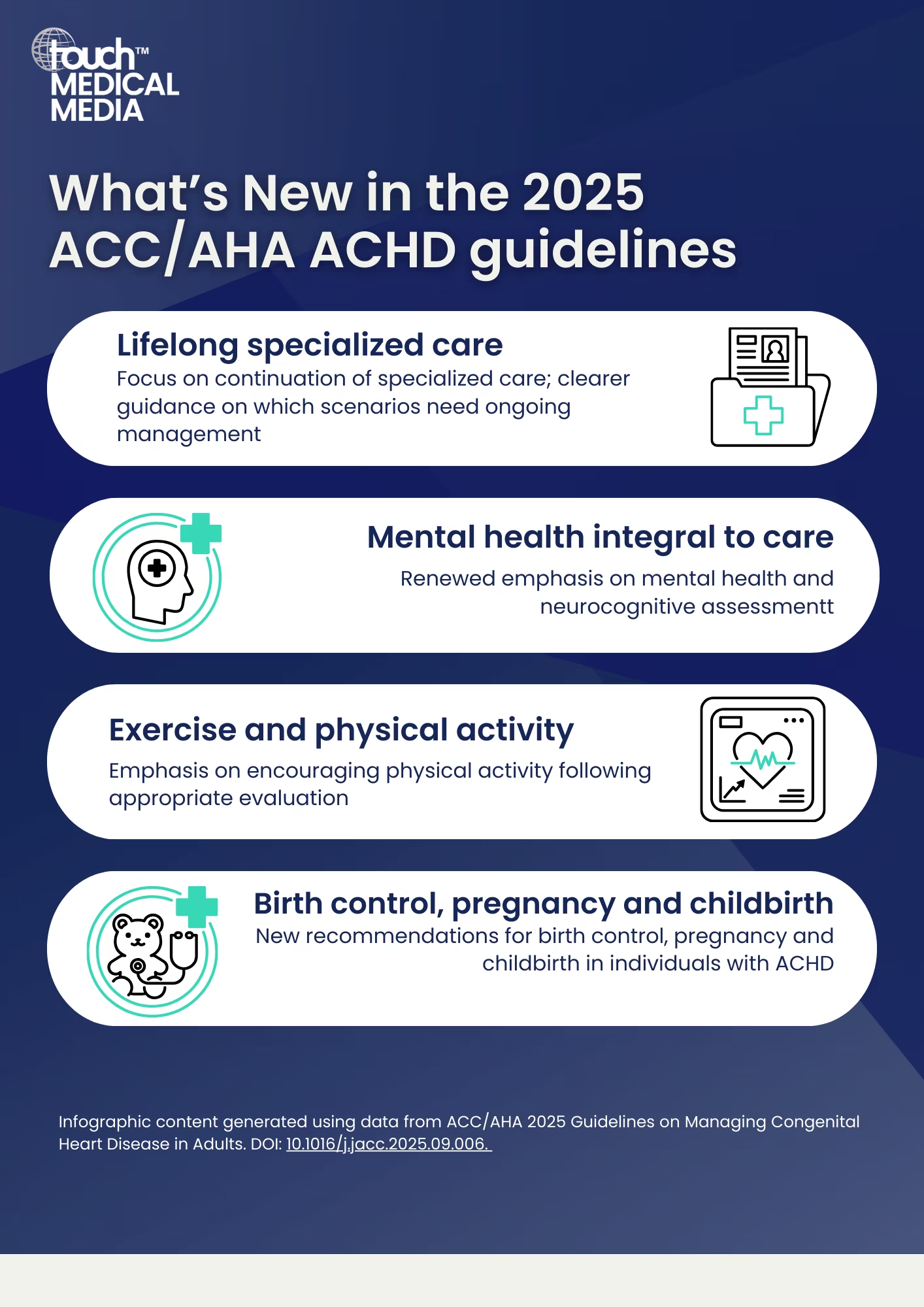
This years’ guideline update represents a shift in emphasis to continuity of specialized care, broader attention to mental and functional health, and more proactive guidance on exercise, pregnancy and heart failure.
How the guideline was developed
The guideline was produced using the ACC/AHA’s established evidence-based methodology. A multidisciplinary writing committee spanning ACHD cardiology, interventional cardiology, congenital cardiac surgery, electrophysiology, heart failure, advanced practice nursing, and patient advocacy systematically reviewed the literature published between 2017 and 2024. Evidence was graded by strength and quality, and recommendations were assigned a class (benefit versus risk) and level of evidence.
Notably, the authors acknowledge that much of ACHD care still rests on observational data and expert consensus rather than randomized trials. However, compared with 2018, the volume and quality of evidence has expanded substantially, reflecting what guideline chair Michelle Gurvitz, MD, describes as “almost exponential” growth in ACHD research over recent years. The final recommendations were developed through consensus and peer review, and have received endorsement from key societies such as the Heart Rhythm Society (HRS), the Society for Cardiovascular Angiography and Interventions (SCAI) and the International Society for Adult Congenital Heart Disease (ISACHD).
What’s changed—and why it matters in practice
1. A stronger mandate for lifelong specialized care
While the 2018 guideline emphasized the importance of ACHD expertise, the 2025 update goes further in defining when and how specialty care should be involved. The new document provides clearer guidance on which lesions and clinical scenarios warrant ongoing management by ACHD specialists and how care can be shared with general cardiologists and primary care clinicians.
This reflects a persistent problem: many patients disengage from care during the transition from paediatric to adult services or lose access due to geography or insurance. The updated guideline reframes continuity of care as a core quality issue, not a “nice to have.”
Clinical takeaway: If you are seeing an adult with repaired or unrepaired congenital heart disease—even if they appear stable—this guideline strengthens the case for formal linkage with an ACHD centre.
2. Mental health and neurocognition move to the foreground
Mental health received relatively limited attention in earlier guidelines. In contrast, the 2025 update explicitly recommends routine consideration of anxiety, depression and neurocognitive impairment, recognizing their high prevalence and impact on adherence, functional status and outcomes.
This is a meaningful shift: mental health is no longer framed as ancillary, but as integral to cardiovascular care in ACHD.
Clinical takeaway: Screening for mood and cognitive disorders and referring when appropriate is now part of guideline-concordant ACHD care.
3. Exercise: From restriction to prescription
One of the most practice-changing updates involves physical activity. Historically, many patients with ACHD were advised, explicitly or implicitly, to limit exercise. The new guideline reframes this narrative, encouraging physical activity for most patients with ACHD after appropriate evaluation.
Exercise testing is now more clearly positioned as a tool to individualize recommendations, rather than defaulting to conservative restrictions.
Clinical takeaway: Instead of telling patients what not to do, clinicians are encouraged to help patients with ACHD safely engage in regular physical activity, including sports, when appropriate.
4. Expanded, clearer guidance on pregnancy and reproductive health
Building on earlier recommendations, the updated guideline provides more detailed advice on contraception, preconception counselling and pregnancy management. It emphasizes collaborative care involving specialists in ACHD and outlines risk stratification for maternal and foetal outcomes.
Importantly, the guideline reinforces that most patients with ACHD can have a safe pregnancy with proper planning and monitoring—a message that counters lingering misconceptions.
Clinical takeaway: Preconception counselling is no longer optional. Early referral and shared decision-making are central to care.
5. Heart failure and advanced therapies: Catching up with reality
As patients with ACHD age, heart failure is increasingly common. The new guideline expands recommendations on surveillance, timing of interventions and consideration of advanced therapies including devices and transplantation, particularly for patients with complex lesions.
While evidence gaps remain, the guidance reflects real-world practice more closely than prior versions.
Clinical takeaway: Heart failure management in patients with ACHD now warrants the same level of proactive planning as in acquired heart disease, tailored to congenital anatomy.
The bottom line
The 2025 ACC/AHA ACHD guideline is not just an update, it is a recalibration. It acknowledges that patients with ACHD are living longer, fuller and more complex lives, and it challenges clinicians to move beyond episodic, lesion-focused care. For busy physicians, the message is clear: prioritize continuity, address mental and functional health, encourage safe activity, and engage early around pregnancy and heart failure. The population is growing, and this guideline offers a timely, pragmatic framework to keep pace.
References
- Gurvitz M, Krieger EV, Fuller S, et al. 2025 ACC/AHA/HRS/ISACHD/SCAI Guideline for the Management of Adults With Congenital Heart Disease: A Report of the American College of Cardiology/American Heart Association Joint Committee on Clinical Practice Guidelines. JACC. Preprint. DOI: 10.1016/j.jacc.2025.09.006. Available at: www.jacc.org/doi/10.1016/j.jacc.2025.09.006 (accessed 19 December 2025).
- Krittanawong C, Moore MM, Cibotti-Sun M. 2025 Adults with Congenital Heart Disease Guideline-at-a-Glance. 2025. Available at: www.jacc.org/doi/10.1016/j.jacc.2025.11.007 (accessed 19 December 2025).
Cite: A new roadmap for a growing population: What busy clinicians need to know about the 2025 ACHD guideline. touchCARDIO. 19 December 2025.
Editor: Heather Hall, Managing Editor.
Disclosures: This article was created by the touchCARDIO team utilizing AI as an editorial tool (ChatGPT (GPT-5.1) [Large language model]. https://chat.openai.com/chat.) The content was developed and edited by human editors. It is not affiliated with the American College of Cardiology (ACC) or American Heart Association (AHA). Views expressed are the speaker’s own and do not necessarily reflect the views of Touch Medical Media. No funding was received in the publication of this article.
Related content:

SIGN UP to touchCARDIOLOGY!
Join our global community today for access to thousands of peer-reviewed articles, expert insights and learn-on-the-go education across 150+ specialties, plus concise email updates and newsletters so you never miss out.