Transthyretin amyloid cardiomyopathy (ATTR-CM) is a progressive infiltrative cardiomyopathy caused by the deposition of misfolded transthyretin (TTR), in the form of insoluble amyloid fibrils, within the myocardial extracellular space. Patients typically experience a progressive decline in functional capacity, worsening heart failure symptoms and recurrent heart failure hospitalizations, followed by the development of advanced end-stage disease that ultimately results in cardiovascular mortality.1
Until recently, ATTR-CM was considered a rare and untreatable disease. However, improvements in diagnostics, awareness among clinicians and the advent of highly specific disease-modifying therapies are challenging these long-held assumptions. In recent years, there has been a dramatic upsurge in diagnoses, coupled with patients being diagnosed earlier in the disease course and surviving longer from the time of diagnosis.2 Improvements in outcomes have been further compounded by the wider availability of transthyretin amyloidosis (ATTR)-specific disease-modifying therapies and an improvement in the understanding of how conventional heart failure therapies can be used in this population.3–5
This article will explore how changes in the baseline characteristics of patients with ATTR-CM have influenced the design of randomized controlled trials (RCTs), and how these evolving characteristics may shape future strategies to address the unmet clinical needs of this population.
Evolving clinical trial populations over time
The clinical phenotype of patients diagnosed with ATTR-CM has changed dramatically over the last couple of decades. Patients are now being diagnosed earlier in the course of their disease, as evidenced by a shorter duration of symptoms prior to diagnosis, more favorable biochemical profiles and echocardiographic parameters.2 This has been driven in part by greater awareness among clinicians, as evidenced by the increase in referrals to specialist amyloidosis centers, as well as by the advent of effective disease-modifying therapies, which has created an impetus to diagnose and treat patients earlier.
Advances in diagnostic imaging have also facilitated earlier diagnosis. Recognition of characteristic echocardiographic features, such as the apical-sparing strain pattern, together with the wider availability of advanced modalities including cardiac magnetic resonance (CMR) with multiparametric mapping and bone scintigraphy, has enabled clinicians to more readily identify patients with suspected ATTR-CM.6 The improved sensitivity of CMR and bone scintigraphy has even enabled clinicians to establish a diagnosis before characteristic structural and functional changes are identifiable on echocardiography.7 Furthermore, most patients are now diagnosed using the non-biopsy pathway, which combines bone scintigraphy with biochemical testing. By removing the need for histological confirmation of amyloid, this approach has simplified the diagnostic pathway and made it substantially easier to establish an earlier diagnosis.8,9
These changes are also apparent in the populations of patients recruited into clinical trials over the past decade. The ATTR-ACT trial (Safety and Efficacy of Tafamidis in Patients With Transthyretin Cardiomyopathy [ATTR-ACT]; ClinicalTrials.gov identifier: NCT01994889) was a seminal phase 3 RCT and the first to demonstrate that an ATTR-specific disease-modifying therapy could improve outcomes in ATTR-CM.10 This trial recruited patients between December 2013 and August 2015. The population enrolled in ATTR-ACT differed substantially from those enrolled in subsequent trials with more recent recruitment periods. APOLLO-B (APOLLO-B: A Study to Evaluate Patisiran in Participants With Transthyretin Amyloidosis With Cardiomyopathy [ATTR Amyloidosis With Cardiomyopathy]; ClinicalTrials.gov identifier: NCT03997383), ATTRibute-CM (Efficacy and Safety of AG10 in Subjects With Transthyretin Amyloid Cardiomyopathy [ATTRibute-CM]; ClinicalTrials.gov identifier: NCT03860935) and HELIOS-B (HELIOS-B: A Study to Evaluate Vutrisiran in Patients With Transthyretin Amyloidosis With Cardiomyopathy; ClinicalTrials.gov identifier: NCT04153149) all began recruiting patients in 2019.11–13 The enrollment of a more contemporary patient population meant that patients entered these trials earlier in the course of their disease. This is reflected by their greater functional capacity, as measured by the 6 min walk test, a lower burden of heart failure symptoms, as assessed by Kansas City Cardiomyopathy Questionnaire (KCCQ) score and New York Heart Association (NYHA) class, and more favorable biomarker profiles (Table 1).10–13
Table 1: Baseline characteristics of the randomized controlled trial populations10–13
| Characteristics | ATTR-ACT (NCT01994889)10 | APOLLO-B (NCT03997383)11 | ATTRibute-CM (NCT03860935)12 | HELIOS-B (NCT04153149)13 | ||||
| Tafamidis (n=264) | Placebo (n=177) | Patisiran (n=181) | Placebo (n=178) | Acoramidis (n=421) | Placebo (n=211) | Vutrisiran (n=326) | Placebo (n=329) | |
| Enrollment dates | December 2013–August 2015 | October 2019–May 2021 | April 2019–October 2020 | December 2019–August 2021 | ||||
| Age, years | 75.0 (46–88) | 74.0 (51–89) | 76.0 (47–85) | 76.0 (41–85) | 77.4 (6.5) | 77.1 (6.8) | 77.0 (45–85) | 76.0 (46–85) |
| Male sex, n (%) | 241 (91.3) | 157 (88.7) | 161 (89.0) | 160 (90.0) | 384 (91.2) | 186 (88.2) | 299 (92.0) | 306 (93.0) |
| ATTRwt, n (%) | 201 (76.1) | 134 (75.7) | 144 (80.0) | 144 (81.0) | 380 (90.3) | 191 (90.5) | 289 (89.0) | 289 (88.0) |
| ATTRv, n (%) | 63 (23.9) | 43 (24.3) | 37 (20.0) | 34 (19.0) | 41 (9.7) | 20 (9.5) | 37 (11.0) | 39 (12.0) |
| Val122Ile, n (%) | N/A | N/A | 17 (46.0) | 12 (35.0) | 24 (58.5) | 12 (60.0) | 24 (65.0) | 25 (64.0) |
| 6MWT distance, m | 350.6 (121.3) | 353.3 (126.0) | 358.0 (295.0–420.0) | 367.7 (300.0–444.3) | 364.0 (103.0) | 351.0 (102.0) | 372.0 (103.7) | 377.1 (96.3) |
| KCCQ-OS score | 67.3 (21.4) | 65.9 (21.7) | 69.8 (21.2) | 70.3 (20.7) | 71.7 (19.4) | 70.5 (20.7) | 73.0 (19.4) | 72.3 (19.9) |
| NT-proBNP, ng/mL | 2,995.9 | 3,161.0 | 2,008.0 | 1,813.0 | 2,326.0 | 2,306.0 | 2,021.0 | 1,801.0 |
| Troponin I, ng/mL | 140.0 | 140.0 | 64.0 | 60.2 | N/A | N/A | 71.9 | 65.2 |
| NYHA class I, n (%) | 24 (9.1) | 13 (7.3) | 10 (6.0) | 15 (8.0) | 51 (12.1) | 17 (8.1) | 49 (15.0) | 35 (11.0) |
| NYHA class II, n (%) | 162 (61.4) | 101 (57.1) | 156 (86.0) | 150 (84.0) | 293 (69.6) | 162 (76.8) | 250 (77.0) | 258 (79.0) |
| NYHA class III, n (%) | 78 (29.5) | 63 (35.6) | 15 (8.0) | 13 (7.0) | 77 (18.3) | 32 (15.2) | 27 (8.0) | 35 (11.0) |
| Follow–up duration (months) | 30 | 12 | 30 | 33–36 | ||||
Continuous results are displayed either as mean ± SD or median (IQR) and categorical are n (%).
ATTRv = variant transthyretin amyloidosis; ATTRwt = wild-type transthyretin amyloidosis; KCCQ-OS = Kansas City Cardiomyopathy Questionnaire–Overall Summary; 6MWT = 6 min walk test; N/A = not applicable; NT-proBNP = N-terminal pro-B-type natriuretic peptide; NYHA = New York Heart Association.
Coupled with the milder disease stage at enrollment, patients in the placebo arms of more recent clinical trials appear to deteriorate more slowly, with a smaller decline in 6 min walk test distance and KCCQ score over the course of the trial. This is also reflected in event rates, with the rate of all-cause mortality and cardiovascular hospitalizations being higher in the ATTR-ACT trial than in the more recent clinical trials.14
Clinical outcomes have also improved due to the background use of ATTR-specific disease–modifying therapies. Since the ATTR-ACT trial and the subsequent approval of tafamidis for the treatment of ATTR-CM, the use of TTR stabilizers as background therapy in RCTs has increased.10 This trend was first observed in ATTRibute-CM, where initiation of tafamidis was permitted 12 months after randomization and has become more prominent in HELIOS-B, in which patients already receiving tafamidis were eligible for enrollment and initiation during the trial was also allowed.12,13 Recent studies have enhanced understanding of the role of conventional heart failure therapies in ATTR-CM. A large retrospective analysis demonstrated that mineralocorticoid receptor antagonists and low-dose beta-blockers, in patients with reduced ejection fraction, were associated with improved survival.4 A further retrospective study reported that sodium–glucose cotransporter 2 inhibitors were also associated with improved survival.5 Optimized use of these therapies may therefore further improve clinical outcomes and potentially contribute to lower event rates in clinical trials.
Changes in clinical trial designs over time
These observations have important implications for the design of clinical trials evaluating novel therapies. Demonstrating a treatment effect depends on patients in the placebo arm experiencing sufficient clinical deterioration. If the rate of deterioration has slowed in more recent years, then study population sizes, endpoints and follow-up durations based on earlier trials may no longer be appropriate or adequately powered to evaluate the efficacy of new agents.
These changes have already begun to influence trial design. More recent trials have substantially increased their sample sizes, culminating in CARDIO-TTRansform, which has enrolled 1,438 patients.15 Recent trials, including HELIOS-B and CARDIO-TTRansform, have also broadened their composite endpoints to include urgent heart failure visits as part of recurrent cardiovascular events. Including urgent heart failure visits aims to capture the full spectrum of clinically meaningful cardiovascular events and, in doing so, accounts for events that typically occur earlier in the disease course and precede cardiovascular hospitalization. The duration of follow-up has also been extended in more recent trials. This is particularly evident in HELIOS-B and CARDIO-TTRansform, in which the primary endpoint is assessed over 156 weeks and 140 weeks, respectively. The extended follow-up is intended to capture a greater number of clinically meaningful events, thereby increasing statistical power to detect differences in mortality and cardiovascular hospitalization, particularly as patients are diagnosed earlier and disease progression is increasingly attenuated by effective therapies.13,15 Despite these modifications, topline results from CARDIO-TTRansform indicate that the trial did not meet its primary endpoint.16 Detailed analyses will be important to determine whether this reflects the characteristics of the enrolled population, widespread use of background disease-modifying therapies, endpoint selection or other aspects of trial design. Regardless of the final explanation, the findings highlight the increasing challenges of demonstrating incremental clinical benefit in an era of earlier diagnosis and improving standards of care and emphasize the need to optimize patient selection and endpoint strategies in future ATTR-CM trials.
The slower disease progression observed in the placebo arms of more contemporary clinical trials has also resulted in smaller differences in secondary and exploratory outcomes between the treatment and placebo groups. It has therefore become increasingly important to define what constitutes a clinically meaningful change in these measures. Recent studies have sought to establish clinically meaningful thresholds for commonly used clinical markers by identifying the degree of change associated with an increased risk of mortality. A clinically significant increase in N-terminal pro-B-type natriuretic peptide (NT-proBNP) was defined as a rise of >700 ng/L and >30% at 1 year, while a clinically significant decline in estimated glomerular filtration rate was defined as a reduction of >20% at 1 year.17,18 Similarly, an absolute reduction of >35 m or >5% in 6 min walk test distance was associated with an increased risk of mortality, as was the need for out-patient diuretic intensification.17,19 These definitions have been used in post hoc analyses to demonstrate that disease-modifying therapy can achieve disease stability or even a clinically meaningful improvement in a significant proportion of patients.20–23 These markers could be incorporated into future clinical trials to facilitate the assessment of the efficacy of novel therapies.24
As patients are diagnosed earlier in the course of their disease and traditional endpoints such as all-cause mortality and cardiovascular hospitalizations occur less frequently, relying solely on these endpoints may make trials inefficient and also fail to capture additional treatment benefits that matter to patients.2 Future endpoints should be meaningful to both patients and clinicians and capture not only whether patients survive longer but also whether they remain functionally independent, symptomatically stable and free from disease progression. Novel endpoint strategies could integrate hard clinical events with sustained changes in functional capacity, quality of life and objective measures of disease status, providing greater sensitivity to detect treatment effects earlier in the disease course. However, this approach must be balanced against the need to prioritize clinically meaningful outcomes that are acceptable to regulatory authorities for the approval of novel therapies. It is noteworthy that although the APOLLO-B trial demonstrated that treatment with patisiran resulted in a slower decline in 6 min walk test distance, the U.S. Food and Drug Administration declined the application to approve patisiran for the treatment of ATTR-CM, expressing concerns that the small effect size was not clinically meaningful.11,25 Hierarchical endpoint analyses may offer a potential solution by assigning greater weight to traditional hard clinical outcomes while also capturing the impact of treatment on patient-centered measures and objective markers of disease progression.
Recent studies have also sought to use advanced cardiac imaging to demonstrate the efficacy of disease-modifying therapies, with CMR-derived myocardial extracellular volume (ECV) measurements serving as a surrogate marker of cardiac amyloid burden.26–29 These approaches aim to provide more granular insight into how disease-modifying therapies directly affect myocardial amyloid deposition and are likely to become increasingly important for evaluating novel therapies designed to accelerate the clearance of amyloid fibrils from the heart. The incorporation of advanced cardiovascular imaging into clinical trials provides important mechanistic insights into how therapies influence both the underlying myocardial substrate and the downstream consequences on cardiac structure and function. CMR, particularly ECV mapping, enables direct quantification of myocardial amyloid burden, offering a biologically specific measure of disease modification that complements conventional clinical and functional endpoints. Unlike structural parameters such as wall thickness or left ventricular mass, which reflect the cumulative effects of amyloid infiltration, hypertrophy and remodeling, changes in ECV are a direct reflection of amyloid fibril accumulation and are more likely to occur earlier in the disease process.6,30,31 Therefore, serial myocardial ECV measurements have the potential to detect treatment effects before differences in mortality or heart failure hospitalization become apparent. Furthermore, multiparametric mapping including native T1 and T2 provides complementary information on myocardial edema, myocardial injury and tissue composition. Rather than serving as stand-alone surrogate endpoints, these imaging biomarkers are likely to play an increasingly important role in understanding therapeutic mechanisms. As patients are diagnosed earlier and disease progression is attenuated, advanced cardiovascular imaging is likely to be increasingly used in future clinical trial design, enabling more sensitive assessment of disease progression and therapeutic response.
Future clinical trials and unmet clinical needs
Amyloid removal
The past decade has seen major advances in drug discovery and the availability of ATTR-specific disease-modifying therapies for patients with ATTR-CM. Treatments currently available in clinical practice can be broadly categorized into TTR stabilizers, which prevent dissociation of the TTR tetramer into amyloidogenic monomers and oligomers and gene silencers, which reduce hepatic production of TTR (the amyloid precursor protein) and thereby limit amyloid fibril formation. Despite their differing mechanisms of action, both therapeutic strategies are primarily aimed at slowing or preventing further amyloid deposition, rather than actively promoting clearance of existing amyloid fibrils within the myocardium.3
There are currently two investigational antibody-mediated ATTR amyloid-depleting therapies being evaluated in phase 3 RCTs. ALXN2220 is a recombinant human anti-ATTR monoclonal immunoglobulin G1 (IgG1) antibody that selectively binds aggregated ATTR and promotes antibody-mediated phagocytosis of amyloid fibrils. In a phase 1 trial of 40 patients, it was well tolerated and, at higher doses, was associated with nominal reductions in NT-proBNP, troponin I and myocardial ECV.32 ALXN2220 is currently being evaluated in DepleTTR-CM, a phase 3 randomized, double-blind, placebo-controlled study assessing its effect on a primary endpoint of all-cause mortality and cardiovascular events.33
Coramitug is a humanized IgG monoclonal antibody that targets an epitope exposed on misfolded TTR. In a phase 2 randomized, double-blind, placebo-controlled trial of 104 patients, it was well tolerated and, at the highest dose (60 mg/kg), resulted in a statistically significant reduction in NT-proBNP.34 Coramitug is currently being evaluated in CLEOPATTRA, a phase 3 randomized, double-blind, placebo-controlled trial assessing its effect on a composite endpoint of cardiovascular mortality and recurrent cardiovascular events.35 These novel agents have the potential to accelerate myocardial amyloid clearance and promote organ recovery, thereby addressing an important unmet need, particularly in patients with advanced disease who currently progress rapidly to end-stage heart failure, multiorgan dysfunction and recurrent hospitalizations.
Optimal magnitude of transthyretin suppression
Various therapies aimed at suppressing hepatic TTR production are at different stages of development, including gene-silencing and gene-editing approaches. In other forms of systemic amyloidosis, treatment-mediated reductions in the amyloid precursor protein (e.g. serum amyloid A protein in serum amyloid A amyloidosis and monoclonal Ig light chains in Ig light-chain amyloidosis) have been associated with improved clinical outcomes, with the magnitude of precursor suppression correlating with prognosis.36,37 However, it remains unclear whether a similar relationship exists in ATTR-CM.
This hypothesis has driven the development of next-generation gene-silencing therapies, including nucresiran (formerly ALN-TTRsc04), a small-interfering RNA that achieves a mean TTR knockdown of >90%, compared with a knockdown of approximately 80% with vutrisiran. The efficacy of nucresiran is currently being evaluated in TRITON-CM, a phase 3 randomized, double-blind, placebo-controlled trial assessing its effect on a composite endpoint of all-cause mortality and recurrent cardiovascular events.38 This study may provide important insights into the relationship between the magnitude of TTR knockdown and clinical outcomes in ATTR-CM.
Nexiguran ziclumeran (nex-z) is a clustered regularly interspaced short palindromic repeats (CRISPR)–CRISPR-associated protein 9-based genome-editing therapy that, following a single administration, achieves deep and sustained TTR knockdown of approximately 90%. A phase 1 study demonstrated that it was well tolerated.39 Its efficacy is currently being evaluated in MAGNITUDE, a phase 3 randomized, double-blind, placebo-controlled trial assessing its effect on a composite endpoint of all-cause mortality and recurrent cardiovascular events.40 Nex-z has the potential to durably suppress TTR production after a single administration, thereby offering a ‘one-time’ therapeutic approach for patients with ATTR-CM.
Although the short- to medium-term TTR knockdown appears safe, further research is needed to establish the long-term effects of TTR suppression. Although the physiological role of the TTR protein appears limited to thyroxine and vitamin A transportation, some animal studies have suggested it also has a neuroprotective role within the central nervous system and may also play a role in regulating metabolism. Reassuringly, there has been no evidence of cognitive or metabolic abnormality in patients receiving gene silencers for more than 5 years. Furthermore, TTR in the cerebrospinal fluid, which is synthesized in the choroid plexus and retinal pigment epithelium, is unaffected by gene-editing therapy, which specifically targets liver production. Concerns have also been raised about the potential for off-target gene editing, and although the risk is deemed low, with complex computational modeling and biochemical assays not showing any evidence of off-target editing, patients who receive gene-editing therapy will require long-term follow-up.41
Efficacy of therapies at different disease stages
The treatment landscape for ATTR-CM is rapidly evolving with multiple therapies with different mechanisms of action on the horizon; however, the optimal treatment strategy for different stages of disease remains undefined. Therapies that are currently available in clinical practice target amyloid fibril production and have demonstrated efficacy in treating patients at an early disease stage.10,12,13 However, the efficacy of both TTR stabilizers and gene-silencing therapies in patients with more advanced disease is currently uncertain. Subgroup analyses across major trials of disease-modifying therapies in ATTR-CM have consistently suggested attenuated treatment effects in this population; however, these studies may have been underpowered to adequately assess efficacy in patients with NYHA class III, given their relatively small representation. This limitation is partly attributable to trial design. Both ATTRibute-CM and HELIOS-B imposed an upper NT-proBNP threshold of 8,500 ng/L, while HELIOS-B additionally excluded patients with NYHA class III symptoms and National Amyloidosis Centre stage III disease.12,13 In contrast, CARDIO-TTRansform does not specify an upper NT-proBNP limit and permits enrollment of patients with a lower 6 min walk test threshold (100 m versus 150 m in other studies).15 The combination of unique inclusion criteria and the unprecendented size of the trial population have resulted in a greater number of patients with NYHA class III symptoms being included; however, because the trial did not not reach its primary endpoint, further studies will be needed to determine the efficacy of these treatment classes in patients with advanced disease.16,42
It is possible that, in more advanced stages of ATTR-CM, suppression of amyloid fibril formation through TTR stabilizers and gene silencers alone may be insufficient to halt disease progression, as a substantial burden of pre-existing amyloid remains within the myocardium. This provides a rationale for therapies that directly target deposited amyloid fibrils and promote their clearance. Amyloid removal represents a major unmet therapeutic need, particularly for patients with advanced ATTR-CM who remain at high risk of progressive heart failure, recurrent hospitalization and multiorgan dysfunction despite contemporary disease-modifying therapies. This has led to the hypothesis that patients with more advanced disease may derive the greatest benefit from antibody-mediated therapies that promote macrophage-mediated clearance of amyloid fibrils already deposited within the myocardium.3 The phase 3 DepleTTR-CM trial has been designed to evaluate this concept, incorporating an NT-proBNP inclusion criterion of >2,000 ng/L to enrich for patients with more advanced cardiac involvement. By targeting a higher-risk population with a substantial burden of established disease, the trial is well positioned to determine whether amyloid depletion with ALXN2220 translates into meaningful improvements in clinical outcomes.33
Combination therapy
Gene silencers typically reduce circulating TTR concentrations by 80–90%; consequently, residual TTR remains in the circulation with the potential to misfold and form ATTR amyloid fibrils. It has been proposed that combining a gene silencer with a TTR stabilizer may therefore enhance therapeutic efficacy through complementary mechanisms of action, resulting in more effective inhibition of amyloid fibril formation.41 The HELIOS-B trial included patients receiving both a gene silencer and a TTR stabilizer; however, interpretation was limited by the relatively small number of patients receiving combination therapy.13 In the CARDIO-TTRansform trial, randomization to eplontersen or placebo was stratified according to baseline treatment with a TTR stabilizer, allowing evaluation of whether eplontersen provides incremental benefit when added to tafamidis. Accordingly, a key secondary endpoint assessed the effect of eplontersen versus placebo on the composite of cardiovascular death and recurrent cardiovascular events in patients receiving tafamidis at baseline.43 However, the topline results indicate that the trial did not meet its primary endpoint. In a prespecified subgroup analysis of patients treated with eplontersen monotherapy compared with placebo, fewer primary composite events were observed, and this result was nominally significant, whereas in patients receiving stabilizer therapy at baseline, no treatment effect was observed.16 These observations raise the possibility that the incremental clinical benefit of combining a TTR gene silencer with a TTR stabilizer may be less than anticipated. Further analyses are required to determine whether combining these two classes of drugs provides additive clinical benefit and identify whether there are any patient sub-populations more likely to benefit from dual-pathway treatment.15
It is also possible that combining two therapies that both aim to reduce TTR amyloid fibril formation may provide only modest incremental benefit. In contrast, combining a fibril-depleting therapy with a stabilizer or a gene silencer may offer a more complementary therapeutic strategy by simultaneously preventing the formation of new amyloid fibrils while promoting clearance of existing myocardial deposits. As a substantial proportion of patients enrolled in both the DepleTTR-CM and CLEOPATTRA trials are expected to be receiving background TTR stabilizer therapy, these studies will provide important insights into whether amyloid depletion confers incremental clinical benefit when added to current standard-of-care treatment and whether combination therapy targeting both amyloid production and removal results in superior clinical outcomes.33,35
Prophylaxis
Although the penetrance of TTR variants remains incompletely defined, carriers of pathogenic TTR mutations are known to be at increased risk of developing ATTR-CM. ACT-EARLY (Acoramidis Transthyretin Amyloidosis Prevention Trial in the Young [ACT-EARLY] Study in Asymptomatic Carriers of a Pathogenic TTR Variant; ClinicalTrials.gov identifier: NCT06563895) is a RCT designed to assess whether treatment with acoramidis can prevent or delay the onset of ATTR-CM in carriers of a known pathogenic TTR variant.44 This represents the first trial to evaluate a disease-modifying therapy as a preventative strategy rather than a treatment for established disease and has the potential to expand the therapeutic landscape to include individuals at risk of developing ATTR-CM. If successful, this could have major implications for all carriers of TTR mutations. The therapeutic landscape in ATTR-CM is increasingly shifting toward earlier intervention, with on-going studies recruiting patients at an earlier disease stage and the focus shifting toward preventing the development of disease. This paradigm reflects the recognition that myocardial amyloid deposition begins long before clinical symptoms develop and that earlier treatment may prevent adverse remodeling. However, detecting the development of minimal disease presents important challenges for endpoint selection. Conventional outcomes such as mortality and heart failure hospitalization occur infrequently in these populations and may require prohibitively long follow-up. Consequently, the ACT-EARLY trial relies on sensitive markers of disease development, such as endpoints derived from advanced cardiac imaging.44 The findings of this trial may have important implications for TTR mutation carriers and provide a rationale for future clinical trials evaluating whether earlier therapeutic intervention, including prophylactic treatment before overt cardiac involvement, can delay disease progression and improve long-term outcomes (Table 2).10–13,33,35,38,40,43,44
Table 2: Summary of the design of previous and on-going randomized clinical trials10–13,33,35,38,40,43,44
| Trial (NCT) | Official title | Randomization/design | Key inclusion criteria | Key exclusion criteria | Primary endpoint | Sample size/target recruitment | Follow-up |
| ATTR-ACT (NCT01994889)10 | A multicenter, international, phase 3, double-blind, placebo-controlled, randomized study to evaluate the efficacy, safety and tolerability of daily oral dosing of tafamidis meglumine 20 mg or 80 mg in comparison with placebo in patients diagnosed with transthyretin cardiomyopathy | Phase 3, randomized, double-blind; 2:1:2 to tafamidis 80 mg, tafamidis 20 mg or placebo | ATTR-CM; age 18–90 years; NT-proBNP >600 ng/mL; 6MWT >100 m | NYHA class IV; eGFR <25 mL/min/1.73 m²; modified BMI <600 | Hierarchical combination of all-cause mortality and cardiovascular hospitalizations | 441 | 30 months |
| APOLLO-B (NCT03997383)11 | A phase 3, randomized, double-blind, placebo-controlled, multicenter study to evaluate the efficacy and safety of patisiran in patients with transthyretin amyloidosis with cardiomyopathy | Phase 3, randomized, double-blind; 1:1 to patisiran versus placebo | ATTR-CM; age 18–85 years; 6MWT ≥150 m; NT-proBNP 300–8,500 ng/mL (600–8,500 if AF) | NYHA class IV; eGFR <30 mL/min/1.73 m²; NYHA class III and NAC stage III | Change from baseline in 6MWT | 360 | 12 months |
| ATTRibute-CM (NCT03860935)12 | A phase 3, randomized, double-blind, placebo-controlled study to evaluate the efficacy and safety of AG10 in patients with symptomatic ATTR-CM | Phase 3, randomized, double-blind; 2:1 to acoramidis versus placebo | ATTR-CM; NT-proBNP 300–8,500 ng/mL; 6MWT ≥150 m | Recent ACS, stroke, revascularization or device implantation; eGFR <15 mL/min/1.73 m² | Hierarchical endpoint of all-cause mortality, cardiovascular hospitalizations, NT-proBNP and 6MWT | 632 | 30 months |
| HELIOS-B (NCT04153149)13 | A phase 3, randomized, double-blind, placebo-controlled, multicenter study to evaluate the efficacy and safety of vutrisiran in patients with transthyretin amyloidosis with cardiomyopathy | Phase 3, randomized, double-blind; 1:1 to vutrisiran versus placebo; background tafamidis permitted | ATTR-CM; NYHA I–III; NT-proBNP >300 and <8,500 ng/mL (>600 if AF); 6MWT ≥150 m | NYHA class IV; eGFR <30 mL/min/1.73 m²; NYHA class III and NAC stage III | Composite of all-cause mortality and recurrent cardiovascular events | 655 | 36 months |
| CARDIO-TTRansform (NCT04136171)43 | A phase 3 global, double-blind, randomized, placebo-controlled study to evaluate the efficacy and safety of ION-682884 in patients with transthyretin-mediated amyloid cardiomyopathy | Phase 3, randomized, double-blind; 1:1 to eplontersen versus placebo on top of standard care | ATTR-CM; NYHA I–III; NT-proBNP ≥600 ng/mL (≥1,200 if AF); 6MWT ≥100 m | Recent ACS, stroke, revascularization, or device implantation | Composite of cardiovascular mortality and recurrent cardiovascular clinical events | 1,438 | 140 weeks |
| MAGNITUDE (NCT06128629)40 | A phase 3, multinational, multicenter, randomized, double-blind, placebo-controlled study to evaluate the efficacy and safety of NTLA-2001 in patients with transthyretin amyloidosis with cardiomyopathy | Phase 3; 2:1 to NTLA-2001 versus placebo | ATTR-CM; stable symptoms; NT-proBNP ≥600 and <10,000 ng/mL; NYHA I–III | Recent cardiovascular instability; eGFR <30 mL/min/1.73 m² | Composite of cardiovascular mortality and cardiovascular events | 1,200 | 18 months to ~5 years, depending on the event rate |
| DepleTTR-CM (NCT06183931)33 | A phase 3, randomized, double-blind, placebo-controlled, multicenter study to evaluate the efficacy and safety of amyloid depleter ALXN2220 in adult patients with ATTR-CM | ALXN2220 versus placebo | ATTR-CM with NYHA II–IV heart failure | Recent ACS, stroke, revascularization or device implantation; LVEF <30%; eGFR <20 mL/min/1.73 m² | Composite of all-cause mortality and recurrent cardiovascular events | 1,185 | 48 months |
| CLEOPATTRA (NCT07207811)35 | CLEOPATTRA: effects of NNC6019-0001 versus placebo on cardiovascular outcomes in patients with ATTR-CM | Randomized coramitug (NNC6019-0001) versus placebo | Age ≥18 years; established ATTR-CM with NYHA I–IV; 6MWT >50 m | Recent ACS, stroke, revascularization or device implantation; LVEF <30%; eGFR <15 mL/min/1.73 m² | Composite of cardiovascular mortality and cardiovascular events | 1,280 | ~4 years |
| TRITON-CM (NCT07052903)38 | TRITON-CM: a phase 3 global, randomized, double-blind, placebo-controlled study to evaluate the efficacy and safety of nucresiran in patients with transthyretin-mediated amyloidosis with cardiomyopathy | Randomized nucresiran versus placebo | Documented ATTR-CM. At least one prior hospitalization for HF or signs and symptoms that require treatment with a diuretic; NT-proBNP <8,500 ng/L | NYHA class IV or NYHA class III and NAC stage III; eGFR <30 mL/min/1.73 m²; prior or current TTR-lowering therapy | Reduction in all-cause mortality and cardiovascular events | 1,250 | Not yet reported |
| ACT-EARLY (NCT06563895)44 | A phase 3, randomized, multicenter, double-blind, placebo-controlled study of acoramidis for transthyretin amyloidosis prevention in the young (ACT-EARLY trial) | Randomized, double-blind, placebo-controlled acoramidis prevention study | Asymptomatic carriers of a pathogenic TTR variant; age 18–75 years and within 10 years of the predicted age of disease onset | Existing ATTR-CM or ATTR-PN; protective TTR variants such as T119M | Time to development of ATTR-CM defined by biopsy or imaging-based diagnosis; time to development of ATTR-PN defined by new signs or symptoms and biopsy-based diagnosis | 587 | 7 years or until the study is declared over |
ACS = acute coronary syndrome; AF = atrial fibrillation;ATTR-CM = transthyretin amyloid cardiomyopathy; ATTR-PN = transthyretin amyloid polyneuropathy; BMI = body mass index;eGFR = estimated glomerular filtration rate; HF = heart failure; LVEF = left ventricular ejection fraction; 6MWT = 6 min walk test; NAC = National Amyloidosis Centre; NT-proBNP = N-terminal pro-B-type natriuretic peptide; NYHA = New York Heart Association; TTR = transthyretin.
Duration of treatment
ATTR-specific therapies are associated with substantial healthcare costs and, as their use expands to patients with earlier-stage disease and potentially presymptomatic mutation carriers, they are likely to place increasing financial pressure on healthcare resources.45 Consequently, defining the optimal duration of therapy will become an important consideration, and this may differ according to the mechanism of action of individual treatment classes. For example, therapies that suppress TTR production or stabilize the native tetramer may require lifelong administration to maintain therapeutic efficacy. In contrast, fibril-depleting therapies have the potential to reduce the existing myocardial amyloid burden, raising the possibility that treatment could be administered for a finite period until a predefined degree of amyloid regression is achieved, after which patients could be maintained on a stabilizer or a gene silencer alone. Whether such an approach is feasible, safe and cost-effective remains unknown and will require prospective evaluation in future clinical trials.
Conclusions
The combination of earlier diagnosis and the availability of highly specific and effective disease-modifying therapies has resulted in contemporary patients with ATTR-CM having a better prognosis than their historical counterparts. This is clearly reflected in contemporary clinical trial populations, in which patients exhibit a milder disease phenotype and lower event rates than those enrolled in earlier trials. This shift has had important implications for trial design, necessitating larger sample sizes and longer follow-up periods to accrue sufficient clinical events to evaluate the efficacy of novel therapies. It has also driven the search for clinically meaningful markers of disease progression that could be incorporated as trial endpoints to increase event rates and improve statistical power. Despite these advances, significant unmet needs remain, including the ability to reverse established amyloid deposition and prevent disease manifestation in at-risk individuals. Addressing these challenges represents the next frontier in ATTR-CM therapeutics and will be a major focus of future clinical trials (Figure 1).
Figure 1: Illustration summarizing the changes in clinical trials and the aims to address future unmet needs
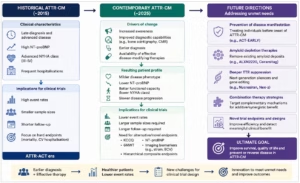
6MWT = 6 min walk test; ATTR-CM = transthyretin amyloid cardiomyopathy; CMR = cardiac magnetic resonance; CV = cardiovascular; ECV = extracellular volume; KCCQ = Kansas City Cardiomyopathy Questionnaire; nex-z = nexiguran ziclumeran; NT-proBNP = N-terminal pro-B-type natriuretic peptide; NYHA = New York Heart Association; TTR = transthyretin