Dr Jazmin Aguado-Sierra discusses how computational models and digital twins are helping researchers understand different heart failure phenotypes, and how artificial intelligence can accelerate analysis and support more personalized approaches.

Computational and data-driven approaches are increasingly being explored as tools to better understand the complex mechanisms underlying cardiovascular disease. At ESC Congress 2026, the session The new toolbox for cardiovascular discovery: from multiomics to computational modelling examined how approaches including electromechanical modelling, spatial multiomics and cardiac digital twins could contribute to precision cardiovascular medicine.
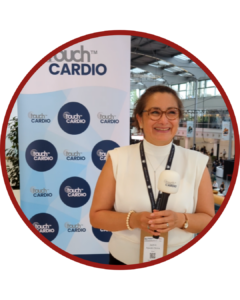 Dr Jazmin Aguado-Sierra, Lead Scientist at ELEM Biotech, presented on electromechanical computational modelling of heart failure. She spoke with touchCARDIO about how digital models can reproduce different forms of heart failure, how AI is accelerating this work, and where these tools may support more personalized treatment decisions.
Don’t miss out on hearing about our latest peer-reviewed articles, expert opinions, conference news, podcasts and more.
What is computational modelling revealing about the different mechanisms underlying heart failure?
Computational modelling is excellently suited to trying to understand the different phenotypes and to translating that information into the clinical scenario.
What we really try to do is capture everything that the different types of heart failure are producing in each patient and then assess, for example, how a particular drug might work in that specific patient. In that way, we are working a lot on stratification and trying to better understand what is best for each type of heart failure.
There is still a lot to learn, but so far we have been able to reproduce different types of heart failure within our digital twins and then use those models to explore differences in response to treatment.
What role is AI playing in advancing computational modelling?
AI increasingly complements our modelling workflow, helping us learn from clinical data, support parameterisation and reduce computation time. in terms of learning from what we observe in the clinic. It is also part of the modelling process in terms of parameterization and helping us reduce the amount of computation time, because these models can become quite computationally expensive.
AI has therefore been a key advance for us. It helps us speed up our computations and everything we create, but it also helps us learn from the data and identify the most important features that we need to capture within our models.
Of course, as with everything, you have to be very careful with AI, depending on where the data come from. I think that is one of the current challenges.
Can AI help researchers manage and analyze the amount of data involved in this work?
Exactly. It helps you analyze your data, produce new models from your data and really speed up all of that human time. But you still have to check everything. You cannot simply leave it on its own.
We really have to be careful about how we use AI. Even when you take those checks into account, however, it can still reduce the amount of time required very dramatically.
How could these approaches contribute to more personalized treatment in the future?
From my perspective, one of the ways AI helps is by accelerating our parameterization and how we capture information. There will still be another layer of personalization over that, though, which is why I say that we have to be careful.
I do not think AI will give you a precision medicine response by itself, but it can help you get closer to that response. By better tailoring all of the data that you put into the AI, you may be able to speed up that process considerably.
It can help you identify the mechanisms much faster and determine which relevant markers you need to take into account. In that way, it can help make the process much faster and better.
Cite: How can computational modelling help personalize heart failure treatment? touchCARDIO. September 2, 2026.
Disclosure: No funding was received in the publication of this article. Thank you to Dr Jazmin Aguado-Sierra for providing her expert insights. Dr Jazmin Aguado-Sierra is Lead Scientist at ELEM Biotech.
Editor: Nicola Cartridge, Director of Content