
Role of the IRS-1 and/or -2 in the pathogenesis of insulin resistance in Dahl salt-sensitive (S) rats
Abstract
Overview
Insulin resistance is a common finding in
hypertensive humans and animal models. The
Dahl salt-sensitive (S) rat is an ideal model of
genetically predetermined insulin resistance
and salt-sensitive hypertension. Along the
insulin signaling pathway, the insulin receptor
substrates 1 and 2 (IRS-1 and -2) are important
mediators of insulin signaling. IRS-1
and/or IRS-2 genetic variant(s) and/or
enhanced serine phosphorylation correlate
with insulin resistance. The present commentary
was designed to highlight the significance
of IRS-1 and/or -2 in the pathogenesis of
insulin resistance. An emphasis will be given
to the putative role of IRS-1 and/or -2 genetic
variant(s) and serine phosphorylation in precipitating
insulin resistance.
Keywords
Dahl S rats, insulin resistance, saltsensitivity, insulin signaling pathway, genetic contributors, molecular contributors.
Article Information
Correspondence
Marlene Shehata, 207-1140 Fisher Avenue, K1Z 8M5, Ottawa, ON, Canada. E-mail: marlenefouad@yahoo.com
Received
2009-05-12T00:00:00
Further Resources

Trending Topic
Cardiovascular diseases (CVDs) are the leading cause of morbidity and mortality worldwide.1 High systolic blood pressure (SBP) remains one of the top risk factors for CVD burden globally.2 Despite being a modifiable risk factor, hypertension (HTN) remains largely undiagnosed and untreated due to inadequate screening, poor awareness and lack of treatment adherence.3 Globally, HTN is undiagnosed in about 46% […]
Cardiovascular diseases (CVDs) are the leading cause of morbidity and mortality worldwide.1 High systolic blood pressure (SBP) remains one of the top risk factors for CVD burden globally.2 Despite being a modifiable risk factor, hypertension (HTN) remains largely undiagnosed and ...

Cardiovascular care continues to evolve in response to increasingly complex clinical realities, where advances in intervention, electrophysiology and population health must be integrated with a more critical appraisal of long-held assumptions. Across disciplines, there is a growing recognition that improving ...

Hypertension is the leading modifiable risk factor for global cardiovascular disease, responsible for an estimated 10.8 million deaths and more than 200 million disability-adjusted life years annually.1 Despite the availability of effective pharmacological and lifestyle interventions, prevalence continues to rise, particularly in ...
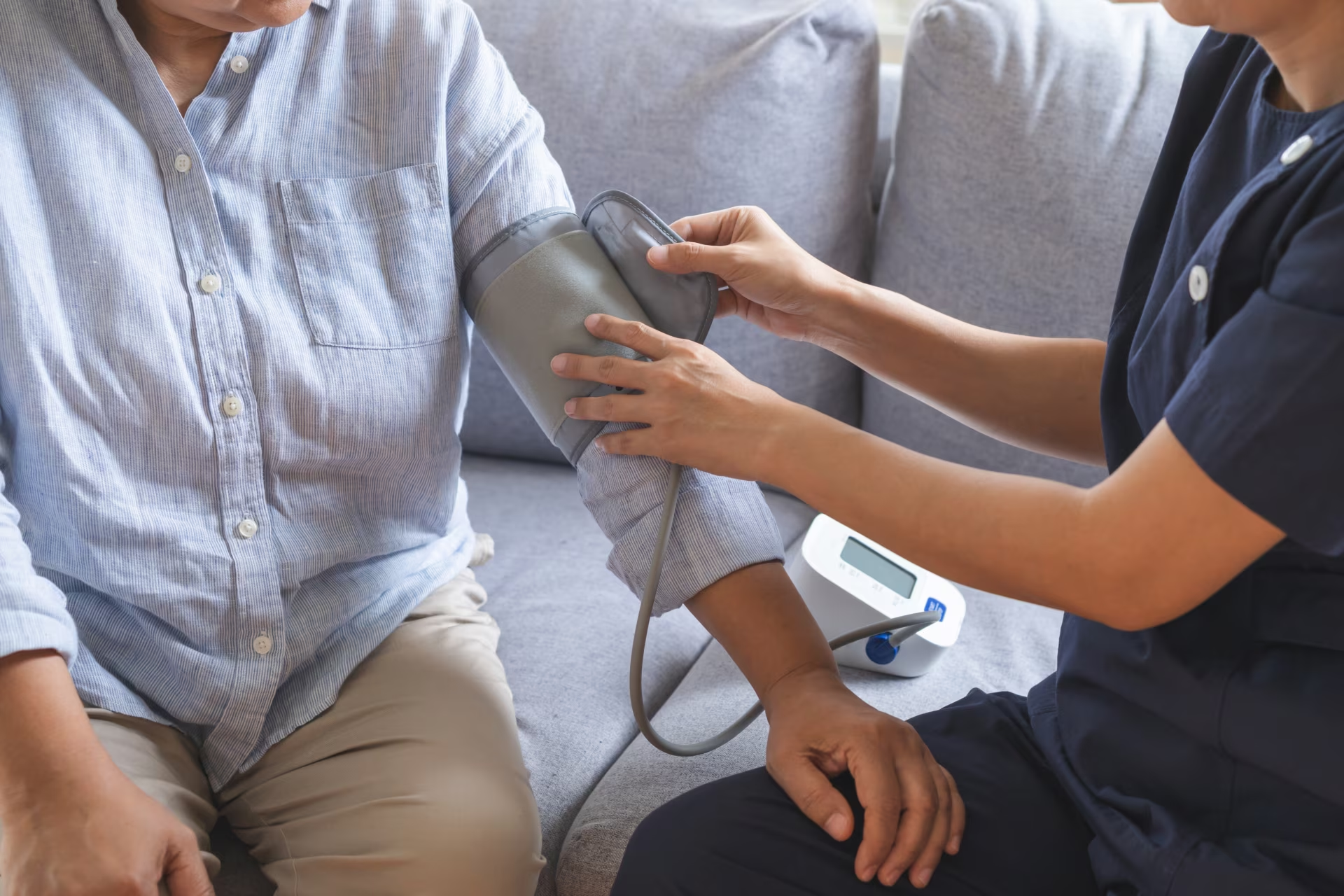
Hypertension affects over 1.4 billion adults worldwide and remains the leading modifiable risk factor for global cardiovascular (CV) morbidity and mortality. It is responsible for an estimated 10.8 million deaths annually and contributes significantly to the global burden of ischaemic heart disease, ...

Hypertension has been associated with increased cardiovascular morbidity and mortality, as well as with overall elevated all-cause mortality.1 Prevalence increases with age, affecting 28.5% of US individuals aged 20–44 years, 58.6% of those aged 45–64 years and 76.5% of those aged 65 years and older.2 In ...

Hypertension (HTN) is one of the largest contributors to cardiovascular (CV) morbidity and mortality in the USA and is estimated to affect 47% of the adult population or approximately 122 million adults older than 20 years of age.1 Recent estimates suggest that over 40% ...

Atrial fibrillation (AF) is one of the most common arrhythmias. It affected 33.5 million people worldwide in 2010, a number that is expected to double by 2050.1 AF prevalence increases with age, and approximately 25% of individuals aged 40 years or older will develop AF ...

Hypertension is a global health problem, with an estimated 1.13 billion individuals affected.1 Patients with hypertension, especially when resistant to conventional therapy, are at high risk of sequelae, e.g., ischaemic heart disease, haemorrhagic and ischaemic stroke, cardiac failure, peripheral vascular ...

...
...
...
...
Log into your Touch Account
Keep track of your clinical interests and newsletter subscriptions.
Sign up with an Email
Or use a .
Register now for FREE access
Already registered? Login below.
