
Imaging
An Introduction to Imaging
Technological innovation has led to many advances in imaging the heart and vascular system, which plays an important role in both diagnosis and management. Imaging modalities include echocardiography, myocardial perfusion imaging via nuclear scintigraphy, MRI and CT. Coronary angiography via coronary catheterization is the gold-standard imaging modality for the visualization of the coronary arteries.
Browse the content below where leading experts discuss the latest data in video interviews and short articles from our conference hub, and browse the selection of peer-reviewed articles from our journal portfolio.
Our supporting partners do not constitute an endorsement of the content on this page.


Native valve infective endocarditis (IE) is rare, with an incidence of 3–7 cases per 100,000 person-years.1,2 Cardiac structural complications from local infection extension include valvular destruction, peri-annular abscess and fistula formation. Left ventricular pseudoaneurysm (LVP) from IE is exceedingly rare, occurring in &...
touchCARDIO Future Leaders 2026 Following the successful introduction last year of our touchCARDIO Future Leaders, we are delighted to announce that nominations are now open for the 2026 edition. This initiative celebrates the next generation of pioneers in cardiology, those whose passion, ...

From ACC26, Dr Matt Budoff shared his highlights, including the new cholesterol guidelines and imaging advances position coronary artery calcium scoring at the heart of personalized cardiovascular risk assessment and prevention.

Cardiovascular medicine continues to advance at a remarkable pace, driven by innovation, interdisciplinary collaboration and an ever-deepening understanding of disease mechanisms. As patient populations age and chronic conditions become increasingly complex, the field stands at the intersection of precision therapy, ...

Epicardial adipose tissue (EAT) is a fat collection directly adjacent to the myocardium and coronary vasculature, lacking any separation and sharing the same circulation.1,2 This anatomy enables direct signalling between EAT and the surrounding tissue, positioning EAT as a central ...
The touchCARDIO journal Heart International has once again seen an increase in its Journal Impact Factor (JIF), rising from 1.9 in 2024 to 2.3 in 2025.

Physician burnout is at a critical point. In this episode, Nicky speaks with Dr Alfred Atanda about why so many physicians are burning out and what can be done to change the trend. From personal experience to system-wide solutions, Dr Atanda shares valuable insights on improving physician well-being and building a more effective healthcare culture.

In this Q&A, we talk to Dr Nadia Chaher shares insights into her career so far, her experiences and the most exciting current innovations in cardio-imaging.
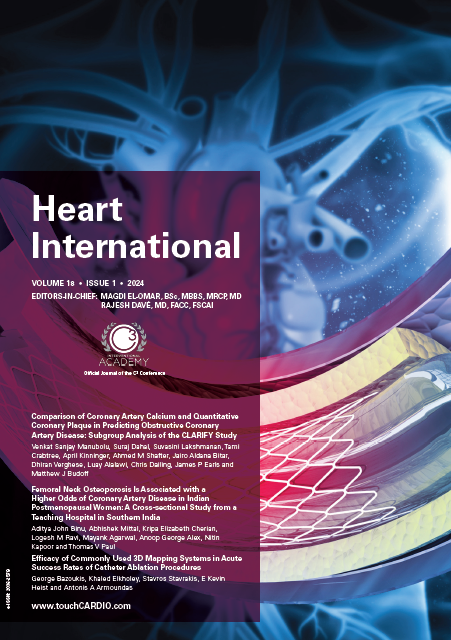
touchCARDIO is delighted to announce that Heart International has received an impressive new Impact Factor of 1.9 in the 2024 Journal Citation Reports (JCR). This achievement marks a notable increase from last year’s Impact Factor of 0.2 and highlights the journal’s growing influence in the cardiology field.

The Yellow III study aimed to assess the effect of evolocumab in combination with statins on plaque morphology in patients with stable coronary artery disease. In this touchCARDIO interview, we speak with Dr Annapoorna Kini (Cardiac Catheterization Laboratory, Mount Sinai ...
Evolocumab is a proprotein convertase subtilisin kexin type 9 inhibitor (PCSK9 inhibitor). When used in combination with statins, reduced plaque volume has been observed in patients with acute coronary syndrome (ACS). In this touchCARDIO interview, we speak with Dr Annapoorna Kini (...

As of the publication of this article, the coronavirus disease 2019 (COVID-19) infection has affected over 400 million people around the world and caused over 6 million deaths.1 Although COVID-19 infection predominantly affects the respiratory system, studies have described a wide spectrum of ...

Federico Asch (MedStar Health Research Institute, Columbia, MD, USA) shares his thoughts on this year’s virtual meeting. Speaker disclosures: Dr Asch has nothing to disclose in relation to this video. Interview and filming supported by Touch Medical Media. Interview ...
Federico Asch (MedStar Health Research Institute, Columbia, MD, USA) discusses the findings of the WASE COVID study, presented at ACC 2021. The study compared AI software-based echocardiography analysis with manual expert analysis to predict mortality based on longitudinal strain and LVEF. ...

More than half of acute coronary syndromes (ACS) occur in subjects with no significant coronary stenosis.1 In view of the number of patients dying each year from a heart attack, the question of identifying these patients is of primary importance. ...

Left main Stenosis Stenting Normalizes Wall Shear Stress of Ascending Aorta in Bicuspid Aortic Valve
Bicuspid aortic valve (BAV) represents the most common congenital cardiac anomaly, with a prevalence ranging between 1% and 2% in the general population.1 BAV is known to be associated with dilation and dissection of the ascending aorta, and the significantly higher shear ...

Anomalous coronary arteries originating from the opposite sinus of Valsalva (ACAOS) is one of the most clinically relevant abnormalities among the wide spectrum of coronary artery anomalies.1 Sudden cardiac death has been related to myocardial bridges, ectopic origin of the ...
Introduction: The restriction of activation mapping to the ventricular surface of contemporary mapping systems often leads to failure to correctly identify the true site of origin (SOO) of intramural and/or sub-epicardial Vas and lower procedural success. Electromechanical wave imaging (...
Log into your Touch Account
Keep track of your clinical interests and newsletter subscriptions.
Sign up with an Email
Or use a .
Register now for FREE access
Already registered? Login below.
